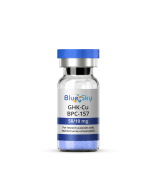
GLOW Blend (GHK-Cu, BPC-157, TB-500) 70mg
Availability: In stock

- Free Priority Shipping
- With Purchase over $75 | USA ONLY


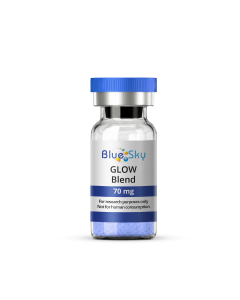
GLOW Blend (GHK-Cu, BPC-157, TB-500) 70mg
| Unit Size | 70 mg/vial |
| Unit Quantity | 1 vial |
| Purity (Mass Spectrometry and UV) | 99.83% Nominal Target: 50 mg GHK-Cu + 10 mg BPC-157 + 10 mg TB-500 |
| Sequence (GHK-Cu) | Gly-His-Lys.Cu.xHAc |
| Sequence (BPC-157) | H-Gly-Glu-Pro-Pro-Pro-Gly-Lys-Pro-Ala-Asp-Asp-Ala-Gly-Leu-Val-OH |
| Sequence (TB-500) |
Ac-Ser-Asp-Lys-Pro-Asp-Met-Ala-Glu-Ile-Glu-Lys-Phe-Asp-Lys-Ser- Lys-Leu-Lys-Lys-Thr-Glu-Thr-Gln-Glu-Lys-Asn-Pro-Leu-Pro-Ser-Lys- Glu-Thr-Ile-Glu-Gln-Glu-Lys-Gln-Ala-Gly-Glu-Ser-OH |
| Molecular Formula (GHK-Cu) | C14H23CuN6O4 |
| Molecular Formula (BPC-157) | C62H98N16O22 |
| Molecular Formula (TB-500) | C212H350N56O78S |
| Appearance | Lyophilized Powder |
| Source | Chemical Synthesis |
| Storage |
Lyophilized Blend GLOW is stable at room temperature for 90 days; however, it is best stored in a freezer at -20°C for any extended period of time. |
| Terms | The products we offer are intended for laboratory research use only. Please familiarize yourself with our terms of service prior to ordering. |
| COA Verification | Verify this COA on MZ Biolabs → |
GLOW Blend 70mg (GHK-Cu / BPC-157 / TB-500)
View Research Overview & References
The GLOW Blend combines three synthetic peptides — GHK-Cu, BPC-157, and Thymosin Beta 4 (TB-500) — into a single lyophilized formulation supplied for in vitro laboratory research. Each component is studied for a distinct cell signaling mechanism, allowing researchers to examine multiple pathways within a single reagent batch.
GHK-Cu Cell Signaling Research
In vitro studies using cultured fibroblasts examined the GHK-Cu tripeptide-copper complex across a range of peptide concentrations, with changes in collagen synthesis detectable within this cell-based system.1
BPC-157 Structural Considerations
BPC-157 is a synthetic pentadecapeptide originally derived from a protein found in gastric juice. Its unusually high proline content, roughly a quarter of its fifteen residues, is understood in peptide chemistry to impose conformational rigidity, a structural feature researchers have linked to the peptide's reported resistance to enzymatic degradation in laboratory assay systems.
Thymosin Beta 4 (TB-500) Cytoskeletal Research
Thymosin Beta 4 is part of the beta-thymosin family of low molecular weight acidic peptides, found in nearly all cell types.
It is studied for its role in cell motility and differentiation, forming a 1:1 complex with monomeric actin (G-actin) to act as an actin buffer that inhibits filament polymerization, relevant to laboratory research on cell migration and differentiation pathways.2
Combined Research Applications
This three-peptide formulation is studied for research into matrix-related signaling and cell-level tissue models across multiple mechanisms within a single controlled research platform.
Combined use of these peptides remains an area of exploratory laboratory research, and available data on multi-peptide interaction effects is preliminary and not considered conclusive.
Analytical Verification for Blended Products
For a three-component blend combining peptides of substantially different sizes, from GHK-Cu's three residues to TB-500's forty-three, analytical verification is understood to require confirmation of each component's individual identity and purity, along with the ratio between them.
Researchers reviewing documentation for this blend are encouraged to look for HPLC or mass spectrometry data resolving all three components as separate peaks.
Storage and Handling in the Laboratory Setting
Given the differing degradation sensitivities of a copper-chelated tripeptide, a proline-rich pentadecapeptide, and a larger methionine-containing protein, the lyophilized blend is stored under sub-zero freezer conditions to preserve all three components' integrity prior to use.
What the Vial Holds by Molecule Count
The nominal masses of 50, 10 and 10 milligrams do not describe the proportions in molecular terms, because the three components differ enormously in weight. GHK-Cu sits near 402 g/mol, BPC-157 near 1,419, and TB-500 near 4,963 — a twelve-fold span from lightest to heaviest.
Converting each mass to moles gives roughly 124 micromoles of GHK-Cu against 7 of BPC-157 and 2 of TB-500. In molecular terms the vial holds approximately sixty GHK-Cu molecules for every one of TB-500.
The blend is therefore dominated by its smallest component to a degree the mass figures alone do not convey, which matters whenever compositional data is interpreted on a molar basis.
One Metal Complex Among Three Components
GHK-Cu is the only component here built around a metal ion, and that makes it chemically distinct from the two plain peptides it is formulated alongside.
Copper is a redox-active metal, meaning it can shift between oxidation states and participate in electron transfer. TB-500 contains a single methionine, the residue most prone to oxidation across the standard amino acids. Co-formulating the two is a recognized consideration in peptide chemistry.
This is one of the reasons the blend is supplied lyophilized rather than in any other form, and why sub-zero storage matters more here than for a single-component product: in the dry, frozen state the mobility required for such interactions is largely absent.
Why Three Components Complicate Quantification
A single aggregate purity figure says little about a three-component blend, because it cannot distinguish correct proportions from a vial weighted toward one component.
Meaningful documentation reports each component separately, which requires a chromatographic method capable of resolving a three-residue metal complex and a forty-three-residue peptide in the same run despite their very different retention behavior. A certificate reporting individual quantities for all three is doing considerably more work than one reporting a single percentage.
Component Names in the Literature
GHK-Cu appears as GHK Copper, Copper Tripeptide-1, and Copper Peptide. BPC-157 appears as Pentadecapeptide BPC 157 and Bepecin. TB-500 appears as Thymosin Beta 4, Thymosin β4, and Tβ4. Each refers to the corresponding sequence shown in the specification table above.
Important Notice
The GLOW Blend is intended exclusively for in vitro laboratory research and is not intended for human consumption, diagnostic use, or therapeutic use. Any application outside of controlled laboratory research is strictly prohibited. These findings do not establish safety, efficacy, or suitability for any human application, and this product has not been evaluated by the FDA or any regulatory agency.
Product Information
The GLOW Blend is supplied as a 70mg lyophilized powder per vial, consisting of 50mg GHK-Cu, 10mg BPC-157, and 10mg Thymosin Beta 4 (TB-500), intended strictly for in vitro laboratory research.
References
1. Maquart FX, Pickart L, Laurent M, Gillery P, Monboisse JC, Borel JP. Stimulation of collagen synthesis in fibroblast cultures by the tripeptide-copper complex glycyl-L-histidyl-L-lysine-Cu2+. FEBS Lett. 1988;238(2):343-346.
2. Huff T, Müller CS, Otto AM, Netzker R, Hannappel E. Beta-Thymosins, small acidic peptides with multiple functions. Int J Biochem Cell Biol. 2001 Mar;33(3):205-20.
- Free Priority Shipping
- With Purchase over $75 | USA ONLY

-
-
-
 Thymosin Beta 4 (TB500) 5mgSpecial Price $31.98 Regular Price $79.95
-
 Thymosin Beta 4 (TB500) 2mgSpecial Price $14.38 Regular Price $35.95
-
 KLOW Blend (GHK-Cu, BPC-157, TB-500, KPV) 80mgSpecial Price $99.98 Regular Price $249.95
-