BPC 157 5mg
Availability: In stock

- Free Priority Shipping
- With Purchase over $75 | USA ONLY



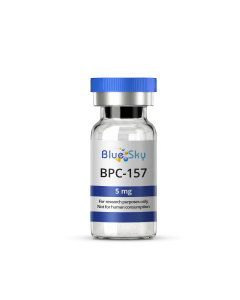
Buy 1 Get 1 Free BPC 157 5mg :
| Unit Size | 5 mg/vial |
| Unit Quantity | 1 vial |
| Purity (Mass Spectrometry and UV) | 99.77% |
| Sequence | H-Gly-Glu-Pro-Pro-Pro-Gly-Lys-Pro-Ala-Asp-Asp-Ala-Gly-Leu-Val-OH |
| Molecular Formula | C62H98N16O22 |
| Appearance | Lyophilized White Powder |
| Source | Chemical Synthesis |
| Storage | Lyophilized BPC 157 is stable at room temperature for 90 days; however, it is best stored in a freezer at -20°C for any extended period of time. |
| Terms | The products we offer are intended for laboratory research use only. Please familiarize yourself with our terms of service prior to ordering. |
| COA Verification | Verify this COA on Freedom Diagnostics → |
BPC 157 5mg
View Research Overview
BPC-157 (Body Protection Compound-157) is a synthetic pentadecapeptide (15 amino acids) originally derived from a protein sequence found in gastric juice.
It is studied in vitro for its interaction with cell signaling pathways relevant to tissue-level cell behavior, including cell migration and proliferation-related signaling.
Peptide Structure and Stability Considerations
BPC-157 is notable among research pentadecapeptides for its unusually high proline content, with roughly a quarter of its fifteen residues being proline.
In peptide chemistry, a proline-dense backbone is understood to impose conformational rigidity, since proline's cyclic side chain restricts the range of rotation available at the peptide bond.
Researchers studying this compound have pointed to this structural feature as a plausible explanation for the peptide's reported resistance to enzymatic degradation, a property that distinguishes it from many other laboratory peptides that break down more readily under similar conditions.
Receptor-Independent Mechanism Considerations
Unlike many bioactive peptides that act through a single, well-defined receptor, BPC-157 has not been linked to one confirmed primary receptor in the research literature, a distinguishing feature researchers frequently note when studying its cell signaling activity.
This has led to research interest in receptor-independent mechanisms, including direct effects on intracellular signaling proteins and cytoskeletal components, as a research framework distinct from classical receptor-ligand pharmacology used for many other short bioactive peptides.
Analytical Purity Verification
As with other synthetic research peptides, BPC-157 batches are commonly verified using a combination of high-performance liquid chromatography (HPLC) and mass spectrometry to confirm both sequence identity and the absence of synthesis byproducts such as truncated or incompletely deprotected fragments.
Purity data reported by these combined analytical methods is generally treated in laboratory settings as a baseline for experiments where dose-response consistency matters, since even small proportions of impurity peptides can confound cell-migration or signaling assay readouts.
Storage and Handling in the Laboratory Setting
Lyophilized peptide is inherently more resistant to degradation than peptide in other forms, which is why laboratories typically retain material in its freeze-dried state under sub-zero freezer storage until shortly before an experimental session.
Laboratory protocols generally recommend limiting exposure to ambient temperature and light while material is held in storage, since both accelerate degradation even in the dry state.
BPC-157 in Comparative Peptide Research
BPC-157 is frequently referenced in the peptide research literature as a point of comparison when investigators evaluate other gut-derived or tissue-signaling peptides, given its distinct proline-rich structural profile relative to more conventional linear peptide sequences.
Researchers designing in vitro protocols involving fibroblast or epithelial cell signaling often cite BPC-157 alongside other tissue-signaling peptides under study, using its documented stability data as a benchmark for experimental design.
Origin of the Name
The designation attached to this compound dates to the research context in which the parent protein was first described. It is a historical label carried forward through the literature and catalog listings, not a characterization of any verified activity, and the peptide is supplied here strictly as a research reagent.
The shorthand BPC-157 is what appears in most published work, with the number distinguishing this particular fifteen-residue sequence from other fragments studied alongside it.
A Fragment Rather Than an Isolated Peptide
This sequence was identified as a portion of a larger protein found in gastric juice, not as a short peptide circulating on its own. The fifteen residues shown in the specification table were selected from that larger sequence and are produced synthetically.
That distinction matters when reading the literature. Work described as studying this peptide is studying a synthetic construct, not a natural product isolated intact, and comparisons with the parent protein are comparisons between a fragment and the whole.
Seven Residues at Opposite Extremes
Alongside its four prolines, the sequence carries three glycines, at positions 1, 6 and 13. These two residues sit at opposite ends of the flexibility scale among the standard amino acids.
Proline's ring locks the backbone into a restricted set of angles. Glycine, having no side chain beyond a single hydrogen, permits rotations that no other residue allows. Seven of these fifteen positions are therefore occupied by one or the other extreme.
The result is a chain alternating between rigid segments and unusually mobile hinges rather than one of uniform character, which is relevant to how the peptide is treated in conformational and structural studies.
Charge Across a Short Sequence
Four of the fifteen residues carry ionizable side chains: a glutamate at position 2, aspartates at positions 10 and 11, and a single lysine at position 7. Both termini are free, the N-terminus as an amine and the C-terminus as a carboxylic acid.
Three acidic side chains against one basic leaves the peptide net negative near neutral pH, with the two adjacent aspartates concentrating negative charge in the back half of the chain.
Important Notice
BPC-157 is provided exclusively for laboratory research purposes (in vitro). This peptide is not intended for human consumption or use, and any application outside of controlled laboratory research is prohibited. These findings do not establish safety, efficacy, or suitability for any human application, and have not been evaluated by the FDA or any regulatory agency.
Product Information
BPC-157 is supplied as a lyophilized powder for laboratory research use only.
- Free Priority Shipping
- With Purchase over $75 | USA ONLY

-
 Thymosin Beta 4 (TB500) 5mgSpecial Price $31.98 Regular Price $79.95
-
-
-