GHK-Cu 50mg Copper Peptide
Availability: In stock

- Free Priority Shipping
- With Purchase over $75 | USA ONLY



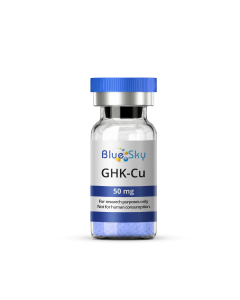
GHK-Cu 50mg Copper Peptide:
| Unit Size | 50 mg/vial |
| Unit Quantity | 1 vial |
| Purity (Mass Spectrometry and UV) | 99.96% |
| Sequence | Gly-His-Lys.Cu.xHAc |
| Molecular Formula | C14H22CuN6O4 |
| Appearance | Lyophilized Powder |
| Source | Chemical Synthesis |
| Storage | Lyophilized GHK-Cu 50mg Copper Peptide is stable at room temperature for 90 days; however, it is best stored in a freezer at -20°C for any extended period of time. |
| Terms | The products we offer are intended for laboratory research use only. Please familiarize yourself with our terms of service prior to ordering. |
| COA Verification | Verify this COA on MZ Biolabs → |
GHK-Cu 50mg Copper Peptide
View Research Overview & References
GHK-Cu, or Glycyl-L-Histidyl-L-Lysine Copper(II), is a synthetic copper peptide created by chelating the GHK peptide with copper ions. It is studied in vitro for its effects on cell signaling pathways related to fibroblast growth factor production and cell proliferation.
Cell Culture Growth Factor Research
In vitro studies using primary dermal fibroblasts, established from surgical specimens, found that GHK-Cu affected cell growth and the autocrine production of basic fibroblast growth factor (bFGF), transforming growth factor beta-1, and vascular endothelial growth factor (VEGF) in both normal and previously irradiated fibroblast cultures.1
These growth factors are studied more broadly in cell biology research for their roles in epithelial repair and angiogenesis-related signaling.2,3
Bone Cell Culture Research
In vitro studies using cultured osteoblastic cells found that the GHK-copper complex affected cell spreading, attachment behavior, and phenotype markers in these bone-forming cell cultures.4
Peptide-Copper Coordination Chemistry
GHK-Cu is studied by peptide chemists as a model system for copper coordination, since the tripeptide's glycine amine, deprotonated backbone amide nitrogen, and histidine imidazole ring together form a square-planar binding pocket for the Cu2+ ion.
This coordination geometry closely resembles the copper-binding motif found in serum albumin, making GHK-Cu a frequently cited reference structure in laboratory studies of metal-peptide binding behavior. Researchers examining structure-activity relationships in copper-binding peptides often use this coordination arrangement as a comparative baseline when evaluating synthetic analogs with modified metal affinity.
Analytical Purity and Copper Content Verification
Because GHK-Cu is a metal-peptide complex rather than a purely organic molecule, analytical verification in the laboratory setting typically involves confirming both peptide sequence purity and correct copper stoichiometry.
High-performance liquid chromatography (HPLC) and mass spectrometry are used to confirm the intact complex mass and rule out unchelated GHK peptide or incomplete synthesis byproducts, while the characteristic copper isotope pattern observed in mass spectrometry provides additional confirmation of proper metal incorporation.
Storage and Handling in the Laboratory Setting
Copper-chelated peptides such as GHK-Cu are generally more resistant to enzymatic degradation than their unchelated peptide counterparts, since metal coordination can shield the peptide backbone from proteolytic cleavage.
Even so, laboratories typically store lyophilized material under sub-zero freezer conditions to preserve long-term stability. Because copper ions can participate in redox chemistry, researchers working with this compound in cell-based assays often account for potential interactions with other redox-sensitive assay components when designing experimental controls.
Comparative Research Context Among Copper-Binding Peptides
GHK-Cu is frequently referenced in laboratory literature alongside other naturally occurring copper-binding peptide motifs, including the broader family of ATCUN (amino-terminal Cu(II) and Ni(II) binding) motif peptides studied in bioinorganic chemistry research.
Researchers investigating metal-peptide interactions in cell signaling contexts often cite GHK-Cu's well-characterized coordination chemistry as a benchmark when evaluating newer synthetic copper-binding peptides for laboratory use.
What ".xHAc" Means in the Sequence Row
The sequence row reads Gly-His-Lys.Cu.xHAc, and the third component is worth unpacking. HAc is acetic acid, and the x preceding it indicates that the number of acetic acid molecules is not fixed.
Peptides purified and lyophilized from acetate-containing solutions retain some acetate as a counterion, balancing the charge carried by the basic lysine side chain. The quantity varies between batches according to the final purification and drying conditions, which is why the notation uses a variable rather than a number.
This is also why acetate does not appear in the molecular formula row. A molecular formula states a defined compound, and a variable salt stoichiometry cannot be written as one.
Why the Appearance Row Does Not Say White
Every other entry in this catalog describes a lyophilized white powder. This one says only lyophilized powder, and the difference is chemistry rather than an oversight.
Copper(II) complexes absorb visible light, which is what gives them color. GHK-Cu is blue to blue-violet, and at 50 mg in a vial that color is unmistakable. A white GHK-Cu powder would be a reason to question whether copper had been incorporated at all.
The color therefore serves as a first, crude identity check, available before any instrument is involved.
Copper Has Two Stable Isotopes
The characteristic isotope pattern mentioned above has a specific and recognizable shape. Copper occurs as two stable isotopes, copper-63 and copper-65, in natural abundances of roughly 69 and 31 percent.
Any copper-containing molecule therefore appears in a mass spectrum not as a single peak but as a pair separated by two mass units, the lighter peak roughly twice the height of the heavier one. Carbon, hydrogen, nitrogen and oxygen produce nothing resembling this signature.
That doublet is strong evidence that copper sits within the molecule being measured, rather than merely being present somewhere in the sample, which a total-copper measurement on its own could not distinguish.
The GHK Sequence Occurs in Collagen
GHK is often described as a naturally occurring tripeptide, and the basis for that description is its presence within the sequence of type I collagen, in the alpha-2 chain.
That is why the motif is studied as a native sequence rather than a wholly designed one, and why it appears in literature on collagen-derived fragments as well as in literature on copper coordination chemistry. Glycine, histidine and lysine are all common residues, so the three-residue motif turns up in other proteins too, but the collagen occurrence is the one normally cited.
Important Notice
This GHK-Cu product is strictly intended for in vitro laboratory research only and is not suitable for human or therapeutic use. Any use outside of controlled laboratory settings is prohibited, and these findings do not establish safety, efficacy, or suitability for any human application.
References
1. Pollard JD, Quan S, Kang T, Koch RJ. Effects of copper tripeptide on the growth and expression of growth factors by normal and irradiated fibroblasts. Arch Facial Plast Surg. 2005;7(1):27-31.
2. Steiling H, Werner S. Fibroblast growth factors: key players in epithelial morphogenesis, repair, and cytoprotection. Curr Opin Biotechnol. 2003;14(5):533-537.
3. Powers CJ, McLeskey SW, Wellstein A. Fibroblast growth factors, their receptors, and signaling. Endocr Relat Cancer. 2000;7(3):165-197.
4. Godet D, Marie PJ. Effects of the tripeptide glycyl-L-histidyl-L-lysine copper complex on osteoblastic cell spreading, attachment, and phenotype. Cell Mol Biol (Noisy-le-grand). 1995;41(8):1081-1091.
- Free Priority Shipping
- With Purchase over $75 | USA ONLY

-
-
 Thymosin Beta 4 (TB500) 5mgSpecial Price $31.98 Regular Price $79.95
-
-