KLOW Blend (GHK-Cu, BPC-157, TB-500, KPV) 80mg
Availability: In stock

- Free Priority Shipping
- With Purchase over $75 | USA ONLY



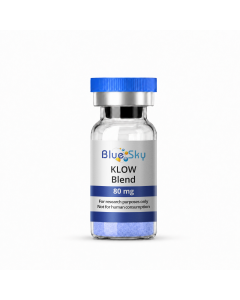
KLOW Blend (GHK-Cu, BPC-157, TB-500, KPV) 80mg :
| Unit Size | 80 mg/vial |
| Unit Quantity | 1 vial |
| Purity (Mass Spectrometry and UV) | 99.87% Nominal Target: 50 mg GHK-Cu + 10 mg BPC-157 + 10 mg TB-500 + 10 mg KPV |
| Sequence (GHK-Cu) | Gly-His-Lys.Cu.xHAc |
| Sequence (BPC-157) | H-Gly-Glu-Pro-Pro-Pro-Gly-Lys-Pro-Ala-Asp-Asp-Ala-Gly-Leu-Val-OH |
| Sequence (TB-500) | Ac-Ser-Asp-Lys-Pro-Asp-Met-Ala-Glu-Ile-Glu-Lys-Phe-Asp-Lys-Ser- Lys-Leu-Lys-Lys-Thr-Glu-Thr-Gln-Glu-Lys-Asn-Pro-Leu-Pro-Ser-Lys- Glu-Thr-Ile-Glu-Gln-Glu-Lys- Gln-Ala-Gly-Glu-Ser-OH |
| Sequence (KPV) | Lys-Pro-Val |
| Molecular Formula (GHK-Cu) | C14H22CuN6O4 |
| Molecular Formula (BPC-157) | C62H98N16O22 |
| Molecular Formula (TB-500) | C212H350N56O78S |
| Molecular Formula (KPV) | C16H30N4O4 |
| Appearance | Lyophilized White Powder |
| Source | Chemical Synthesis |
| Storage | Lyophilized Blend KLOW is stable at room temperature for 90 days, however it is best to store in a freezer below -8°C for any extended period of time. |
| Terms | The products we offer are intended for laboratory research use only. Please familiarize yourself with our terms of service prior to ordering. |
KLOW Blend 80mg (GHK-Cu / BPC-157 / TB-500 / KPV)
View Research Overview & References
The KLOW Blend brings together GHK-Cu, BPC-157, Thymosin Beta 4 (TB-500), and KPV in one lyophilized vial for in vitro laboratory research. Adding KPV to the shared GHK-Cu/BPC-157/TB-500 core extends the formulation into inflammatory cell signaling alongside the matrix and cytoskeletal mechanisms studied for the other three components.
GHK-Cu Coordination Chemistry and Cell Culture Research
GHK-Cu is a tripeptide-copper complex whose glycine amine, backbone amide nitrogen, and histidine imidazole ring together form a square-planar binding pocket for the Cu2+ ion, a coordination geometry that resembles the copper-binding motif found in human serum albumin.
In vitro studies using cultured fibroblasts found that this complex stimulated collagen synthesis within a cell-based system, with the effect observed across a range of peptide concentrations.1
BPC-157 Proline Content and Stability
BPC-157 is a synthetic pentadecapeptide originally derived from a protein found in human gastric juice, distinguished by an unusually high proline content across roughly a quarter of its fifteen residues.
Researchers studying this compound have linked its proline-dense, conformationally rigid backbone to its reported resistance to enzymatic degradation in laboratory assay systems, a structural feature that also underlies its research use in receptor-independent signaling studies.
Thymosin Beta 4 (TB-500) Actin-Binding Research
Thymosin Beta 4 is the most abundant member of the beta-thymosin family of low molecular weight acidic peptides, functioning as the principal G-actin sequestering peptide in the cytoplasm.2
By forming a 1:1 complex with monomeric actin, it inhibits filament polymerization, a mechanism studied in laboratory research on cell migration and differentiation pathways.
KPV Signaling Research in Human Cells
KPV is a tripeptide composed of lysine, proline, and valine, a bioactive fragment derived from the C-terminal region of α-melanocyte-stimulating hormone (α-MSH).
In vitro studies using human keratinocyte cells found that KPV, along with the related fragment MSH 11-13, engaged signaling pathways shared with adrenocorticotropic hormone within this cell-based system.3
Combined Research Applications
This four-peptide formulation is studied for research spanning matrix-related signaling, cytoskeletal dynamics, and cell-based inflammatory signaling pathways within a single controlled research platform.
The addition of KPV distinguishes this formulation from three-peptide blends built on the same GHK-Cu, BPC-157, and TB-500 core, since inflammatory cell signaling data is not otherwise represented. As with any multi-peptide formulation, interaction effects between components remain an exploratory area of laboratory research rather than an established finding.
Analytical Verification for a Four-Component Blend
Spanning a three-residue tripeptide-metal complex, a proline-rich pentadecapeptide, a forty-three-residue protein, and a second unrelated tripeptide, this blend requires analytical methods capable of resolving four chemically distinct components.
Researchers reviewing documentation for this product are encouraged to confirm that HPLC or mass spectrometry data addresses each component individually rather than reporting only an aggregate purity figure.
Storage and Handling in the Laboratory Setting
This four-component blend combines a copper-chelated tripeptide, a proline-rich pentadecapeptide, a larger methionine-containing protein, and a small unprotected tripeptide, each with its own degradation profile.
The lyophilized powder is stored under sub-zero freezer conditions to preserve the integrity of all four components prior to use.
Important Notice
The KLOW Blend is intended exclusively for in vitro laboratory research and is not intended for human consumption, diagnostic use, or therapeutic use. Any application outside of controlled laboratory research is strictly prohibited. These findings do not establish safety, efficacy, or suitability for any human application, and this product has not been evaluated by the FDA or any regulatory agency.
Product Information
The KLOW Blend is supplied as an 80mg lyophilized white powder per vial, consisting of 50mg GHK-Cu, 10mg BPC-157, 10mg Thymosin Beta 4 (TB-500), and 10mg KPV, intended strictly for in vitro laboratory research.
References
1. Maquart FX, Pickart L, Laurent M, Gillery P, Monboisse JC, Borel JP. Stimulation of collagen synthesis in fibroblast cultures by the tripeptide-copper complex GHK-Cu. FEBS Lett. 1988;238(2):343-346.
2. Huff T, Müller CS, Otto AM, Netzker R, Hannappel E. Beta-Thymosins, small acidic peptides with multiple functions. Int J Biochem Cell Biol. 2001 Mar;33(3):205-20.
3. Elliott RJ, Szabo M, Wagner MJ, Kemp EH, MacNeil S, Haycock JW. Alpha-melanocyte-stimulating hormone, MSH 11-13 KPV and adrenocorticotropic hormone signalling in human keratinocyte cells. J Invest Dermatol. 2004;122(4):1010-1019.
- Free Priority Shipping
- With Purchase over $75 | USA ONLY