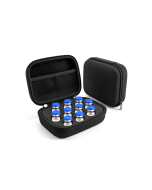
Buy Bulk BPC 157 5MG
Availability: In stock
- Buy 50 for $22.95 each and save 71%
- Buy 100 for $20.95 each and save 74%
- Buy 200 for $19.95 each and save 75%

- Free Priority Shipping
- With Purchase over $75 | USA ONLY



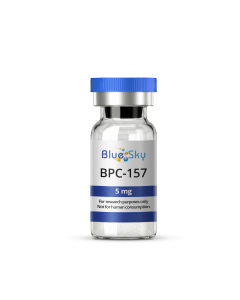
Buy Bulk BPC 157 5MG (No Promo Codes) :
| Unit Size | 5 mg/vial |
| Unit Quantity | 1 vial |
| Purity (Mass Spectrometry and UV) | 99.77% |
| Sequence | H-Gly-Glu-Pro-Pro-Pro-Gly-Lys-Pro-Ala-Asp-Asp-Ala-Gly-Leu-Val-OH |
| Molecular Formula | C62H98N16O22 |
| Appearance | Lyophilized White Powder |
| Source | Chemical Synthesis |
| Storage | Lyophilized BPC 157 is stable at room temperature for 90 days; however, it is best stored in a freezer at -20°C for any extended period of time. |
| Terms | The products we offer are intended for laboratory research use only. Please familiarize yourself with our terms of service prior to ordering. |
| COA Verification | Verify this COA on Freedom Diagnostics → |
BPC 157 5mg (Bulk)
View Research Overview
BPC-157, also referenced in the scientific literature under the designation PL 14736, is a synthetic pentadecapeptide with a molecular weight of approximately 1419 g/mol, corresponding to its 15-residue sequence.
Amino Acid Composition and Charge Distribution
BPC-157's sequence includes two aspartate residues and one lysine, giving the peptide a net acidic character at physiological pH that researchers studying its cell-based activity have noted as a relevant factor in experimental buffer selection.
This composition sits alongside the peptide's defining structural feature: proline accounts for roughly a quarter of its fifteen residues, a proportion understood to impose backbone rigidity given proline's cyclic side chain.
Receptor-Independent Signaling Considerations
Researchers studying BPC-157 in cell-based systems have noted that, unlike many bioactive peptides, it has not been linked to a single confirmed primary receptor in the research literature.
This has directed research interest toward receptor-independent mechanisms, including direct effects on intracellular signaling proteins and cytoskeletal components, a framework that shapes how in vitro assays involving this peptide are typically designed.
Analytical Purity Verification for Bulk Quantities
BPC-157 purity is verified using combined high-performance liquid chromatography (HPLC) and mass spectrometry to confirm sequence identity and rule out truncated or incompletely deprotected synthesis byproducts.
For bulk orders spanning multiple production batches, researchers are encouraged to confirm that each batch carries its own certificate of analysis, since lot-to-lot variability in a proline-rich sequence like this one can be more pronounced than in shorter, simpler peptides.
Storage and Handling in the Laboratory Setting
The proline-dense backbone that confers conformational rigidity also contributes to BPC-157's reported resistance to enzymatic degradation relative to less structurally constrained peptides of similar length.
Even so, lyophilized storage under sub-zero freezer conditions remains standard practice, and researchers receiving a bulk shipment commonly repackage it into several smaller sealed containers at intake rather than repeatedly opening one large supply.
Comparative Research Context in Multi-Peptide Formulations
BPC-157's distinct proline-rich profile is frequently used as a point of structural comparison when researchers evaluate it alongside larger, structurally distinct peptides such as Thymosin Beta 4 in combined laboratory formulations.
This size and structural contrast is a relevant consideration in analytical method design when the two peptides are studied together.
The Triple-Proline Run at Positions 3 to 5
Three of the four prolines in this sequence sit consecutively, at positions 3, 4, and 5, with the fourth at position 8. A run of three prolines in a row is uncommon and has direct consequences for how the peptide is made.
Proline is the hardest standard residue to couple onto a growing chain, because its ring makes the backbone nitrogen a secondary amine rather than a primary one, which is both more hindered and less reactive. Coupling onto a chain that already ends in proline is harder still.
A Pro-Pro-Pro stretch therefore represents three of the most demanding steps in the synthesis, arriving back to back. This is the specific reason deletion sequences are a named concern for this peptide, and why the analytical testing described above is more than routine.
Cis and Trans Proline Bonds
Proline is also the one residue whose preceding amide bond readily adopts two distinct geometries. In nearly every other residue the bond sits almost exclusively in the trans arrangement, but a bond leading into proline populates both cis and trans in meaningful proportions.
Interconversion between the two is slow by molecular standards, on the order of seconds. With four prolines, a preparation of this peptide exists as a mixture of several slowly exchanging conformers rather than a single shape.
In practical terms this can broaden a chromatographic peak or, under some conditions, split it, which is worth bearing in mind when reading a chromatogram for this peptide rather than treating peak shape alone as an indication of impurity.
A Sequence With No Aromatic Residues
BPC-157 contains no tryptophan, no tyrosine, and no phenylalanine. Of the fifteen residues, not one carries an aromatic ring.
That makes detection at 280 nm, the wavelength commonly used to monitor peptides, essentially useless here. Chromatographic analysis of this peptide depends entirely on detection at 214 to 220 nm, where the peptide bonds of the backbone absorb, and a certificate of analysis reporting UV data for this compound should reflect that shorter wavelength.
Alternate Names and Designations
This peptide appears in published work and supplier catalogs as BPC-157, BPC 157, Pentadecapeptide BPC 157, Bepecin, and the development designation PL 14736. Each refers to the same fifteen-residue sequence shown in the specification table above.
Important Notice
BPC-157 is provided exclusively for laboratory research purposes (in vitro). This peptide is not intended for human consumption or use, and any application outside of controlled laboratory research is prohibited. These findings do not establish safety, efficacy, or suitability for any human application, and have not been evaluated by the FDA or any regulatory agency.
Product Information
BPC-157 is supplied as a lyophilized powder for laboratory research use only, available in bulk quantity.
- Free Priority Shipping
- With Purchase over $75 | USA ONLY

-
-
 Blend BPC-157 2mg with Thymosin Beta 4 (TB500) 2mgSpecial Price $28.38 Regular Price $70.95
-
 Blend BPC-157 5mg with Thymosin Beta 4 (TB500) 5mgSpecial Price $58.78 Regular Price $146.95
-
-
-
-
 KLOW Blend (GHK-Cu, BPC-157, TB-500, KPV) 80mgSpecial Price $99.98 Regular Price $249.95