SEMAX 10mg
Availability: In stock

- Free Priority Shipping
- With Purchase over $75 | USA ONLY



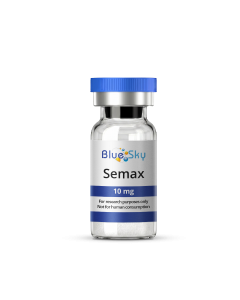
Buy Semax 10mg:
| Unit Size | 10 mg/vial |
| Unit Quantity | 1 vial |
| Purity (Mass Spectrometry and UV) | 99.67% |
| Sequence | H-Met-Glu-His-Phe-Pro-Gly-Pro-OH |
| Molecular Formula | C37H51N9O10S |
| Appearance | Lyophilized White Powder |
| Source | Chemical Synthesis |
| Storage | Lyophilized Semax is stable at room temperature for 90 days; however, it is best stored in a freezer at -20°C for any extended period of time. |
| Terms | The products we offer are intended for laboratory research use only. Please familiarize yourself with our terms of service prior to ordering. |
| COA Verification | Verify this COA on MZ Biolabs → |
Semax 10mg
View Research Overview & References
Semax is a synthetic heptapeptide derived from the 4–10 fragment of adrenocorticotropic hormone (ACTH), a member of the melanocortin peptide family. Its sequence couples that ACTH-derived segment to a C-terminal proline-glycine-proline (Pro-Gly-Pro) motif.
In laboratory research, it is studied in vitro as a melanocortin-related peptide ligand and as a model for how a stabilizing C-terminal motif changes the behavior of a short peptide.
Peptide Structure and Chemistry
Semax is seven residues long with the sequence Met-Glu-His-Phe-Pro-Gly-Pro. The first four residues correspond to ACTH(4–7); the C-terminal Pro-Gly-Pro tripeptide is appended in place of the native ACTH(8–10) sequence.
Its notable structural features include:
- N-terminal methionine: the only sulfur-containing residue, and the primary oxidation site
- His-Phe core: an aromatic pair that is part of the conserved melanocortin recognition region
- C-terminal Pro-Gly-Pro: a proline-rich motif that confers resistance to many aminopeptidases and carboxypeptidases
Both termini are unmodified, leaving a free N-terminal amine and a free C-terminal carboxyl. The glutamate, histidine and free terminal groups together give the peptide good aqueous solubility.
Role of the Proline-Glycine-Proline Motif
Proline is unique among the standard amino acids: its side chain loops back to the backbone nitrogen, forming a ring that constrains the peptide bond and blocks many proteases that require a flexible, extended substrate.
A Pro-Gly-Pro arrangement is a well-studied stabilizing motif in peptide chemistry. The two prolines flank a small, flexible glycine, giving the C-terminus both conformational constraint and resistance to exopeptidase trimming from that end.
This is why Semax is often cited as an example of how appending a glyproline fragment to a bioactive sequence can extend a short peptide's working lifetime in biochemical media relative to the unmodified parent fragment.
Melanocortin Receptor Family Context
Because its N-terminal segment is drawn from ACTH, Semax belongs chemically to the melanocortin ligand family. The melanocortin receptors (MC1R through MC5R) are class A G protein-coupled receptors (GPCRs) that couple primarily to Gαs and raise intracellular cyclic AMP (cAMP).
The conserved recognition element shared across melanocortin peptides is a central His-Phe-Arg-Trp sequence. Semax retains the His-Phe portion of that motif but not the full tetrapeptide, which is consistent with its being studied as a partial or modified melanocortin ligand rather than a full agonist.
Structural biology of this receptor family provides the reference framework for such work. A cryo-EM structure of the melanocortin-4 receptor (MC4R) bound to a peptide agonist and the Gs protein has mapped how melanocortin peptides occupy the binding pocket [1].
An earlier crystal structure of MC4R identified a calcium ion (Ca2+) bound jointly to the receptor and its peptide ligand, and showed that extracellular Ca2+ markedly increases the affinity of the native agonist [2]. This makes calcium concentration a relevant variable in any melanocortin-receptor binding assay.
Relationship to the Parent ACTH Fragment
Semax is a clear illustration of fragment-based peptide design. The starting point is ACTH(4–10), a short natural segment of a much larger hormone; Semax keeps its first four residues and replaces the rest with the Pro-Gly-Pro motif.
Comparing a modified peptide against its parent fragment is a common in vitro exercise. Held side by side, the two let researchers separate the contribution of the retained recognition residues from the contribution of the appended stabilizing motif, across measures such as solution stability and receptor binding.
This design logic—keep the recognition core, modify the periphery for stability—recurs throughout synthetic peptide chemistry, which is part of why short ACTH-derived sequences remain useful reference compounds.
In Vitro Assay Considerations
Melanocortin-related peptides are typically profiled in receptor-expressing cell lines, using assay formats that match the receptors' Gαs coupling:
- cAMP accumulation: the standard functional readout for a Gαs-coupled receptor, run in cells engineered to express a single melanocortin receptor subtype
- Competition binding: displacement of a labeled reference ligand, which estimates affinity rather than functional response
- Subtype selectivity panels: the same measurement repeated across MC1R through MC5R, since the sequence similarity between the five receptors makes cross-reactivity an assumption to be tested rather than excluded
- Parental cell controls: the same host line without the receptor, separating receptor-dependent signal from background
Buffer composition is a specific consideration in this receptor family. Because extracellular calcium participates directly in melanocortin ligand binding, as the crystallographic work cited above describes, calcium concentration is held constant and reported rather than left to vary between runs.
The Sulfur Atom in the Molecular Formula
The S at the end of the molecular formula comes from a single source: the methionine at position 1. No other residue in the sequence contains sulfur.
That sulfur sits in a thioether rather than a thiol, which means there is no free -SH group on this peptide and therefore no possibility of disulfide formation. What it can do is oxidize. Methionine sulfoxide formation adds one oxygen atom, sixteen mass units, and appears in mass spectrometry as a satellite peak sixteen daltons above the parent ion. For a sequence whose only readily labile position is this one residue, that +16 species is the degradation product most worth looking for on a certificate of analysis.
Histidine Makes the Net Charge pH-Dependent
The imidazole side chain of histidine has a pKa near 6, which places it unusually close to the pH range most laboratory buffers occupy. Between pH 6 and pH 7.4 it shifts from largely protonated to largely neutral.
Semax carries that histidine alongside a glutamate, a free N-terminal amine and a free C-terminal carboxyl, so the molecule's overall charge responds to small pH changes more than most short peptides do. In practice this affects chromatographic retention, and it is one reason results for this peptide are not directly comparable between laboratories running different buffer systems.
Reading ACTH Fragment Numbering
References to ACTH(4–10) and ACTH(4–7) follow a numbering convention worth stating plainly: the positions count from the N-terminus of the full 39-residue adrenocorticotropic hormone, so ACTH(4–10) means residues four through ten of that larger sequence.
Semax retains residues four through seven, Met-Glu-His-Phe, and substitutes Pro-Gly-Pro for the remainder. The same compound consequently appears across the literature written as Semax, as ACTH(4–7)-Pro-Gly-Pro, or spelled out residue by residue, all describing the sequence shown in the specification table above.
Important Notice
This product is strictly intended for in vitro laboratory research use only. It is not approved for any form of human consumption, diagnostic procedures, or medical treatment. Its use is restricted to controlled research environments, and these findings do not establish safety, efficacy, or suitability for any human application.
Product Information
Semax is supplied as a lyophilized powder, 10 mg per vial, intended strictly for in vitro laboratory research.
References
- Heyder NA, Kleinau G, Speck D, et al. Structures of active melanocortin-4 receptor–Gs-protein complexes with NDP-α-MSH and setmelanotide. Cell Res. 2021;31(11):1176-1189.
- Yu J, Gimenez LE, Hernandez CC, et al. Determination of the melanocortin-4 receptor structure identifies Ca2+ as a cofactor for ligand binding. Science. 2020;368(6489):428-433.
- Free Priority Shipping
- With Purchase over $75 | USA ONLY