Selank 10mg
Availability: In stock

- Free Priority Shipping
- With Purchase over $75 | USA ONLY



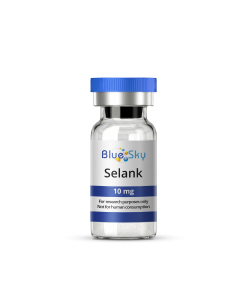
Selank 10mg:
| Unit Size | 10 mg/vial |
| Unit Quantity | 1 vial |
| Purity (Mass Spectrometry and UV) | 99.06% |
| Sequence | H-Thr-Lys-Pro-Arg-Pro-Gly-Pro-OH |
| Molecular Formula | C33H57N11O9 |
| Appearance | Lyophilized White Powder |
| Source | Chemical Synthesis |
| Storage | Lyophilized Selank is stable at room temperature for 90 days; however, it is best stored in a freezer at -20°C for any extended period of time. |
| Terms | The products we offer are intended for laboratory research use only. Please familiarize yourself with our terms of service prior to ordering. |
| COA Verification | Verify this COA on MZ Biolabs → |
Selank 10mg
View Research Overview & References
Selank is a synthetic peptide analog of the natural protein tuftsin, designed exclusively for in vitro laboratory research. Tuftsin, first identified at Tufts University in 1970, is a tetrapeptide derived from the Fc-domain of immunoglobulin (Ig) G.
It plays a significant role in immunomodulation by participating in antigen processing, the formation of reactive oxygen species, and the development of antigen complexes.1,2 Selank mimics tuftsin but includes an additional three amino acids at the C-terminus (Pro-Gly-Pro), which enhances its stability for experimental research.
Development Background
Selank was developed at the Institute of Molecular Genetics of the Russian Academy of Sciences as a stabilized structural analog of tuftsin.
In Vitro Gene Expression Research
In vitro studies using IMR-32 cells, a neuroblastoma cell line, examined the effects of Selank, GABA, and olanzapine on the expression of genes involved in GABAergic neurotransmission.3
This cell-based approach allows researchers to study gene expression changes associated with GABAergic signaling in a controlled cell culture system, providing a basis for further research into Selank's molecular mechanisms at the cellular level.
Peptide Structure: The Pro-Gly-Pro Stabilizing Extension
Native tuftsin (Thr-Lys-Pro-Arg) is understood to be rapidly cleaved by exopeptidases, since its free N-terminal threonine and C-terminal arginine are both readily accessible cleavage sites.
Researchers designing Selank appended a Pro-Gly-Pro tripeptide to the tuftsin C-terminus specifically to sterically hinder this enzymatic degradation, since proline residues are poorly accommodated by many aminopeptidases and carboxypeptidases. This extension is the structural basis researchers cite for Selank's improved in vitro stability relative to native tuftsin.
Analytical Purity Verification
Purity verification for Selank typically combines HPLC and mass spectrometry to confirm the correct 7-residue sequence and free carboxylic acid C-terminus.
Given Selank's proline-rich composition, three of its seven residues, researchers reviewing a certificate of analysis are encouraged to confirm resolution from closely related synthesis byproducts that can arise from incomplete coupling at proline residues, which are more sterically hindered during solid-phase synthesis than most other amino acids.
Storage and Handling in the Laboratory Setting
Lyophilized Selank is stored under sub-zero freezer conditions to preserve integrity between experimental sessions, with the powder kept away from direct light, consistent with standard handling practices for short synthetic research peptides.
Comparative Research Context: Selank and Semax
Selank is frequently studied alongside Semax, another heptapeptide developed by the same Russian research program and sharing the identical Pro-Gly-Pro C-terminal stabilizing motif, though built on a different N-terminal sequence derived from ACTH rather than tuftsin.
Researchers comparing these two peptides have used their shared stabilization strategy but distinct parent sequences to investigate how the same protective structural modification performs across different bioactive peptide scaffolds in cell-based laboratory research.
The First Four Residues Are Tuftsin Itself
Reading the sequence from the N-terminus, Thr-Lys-Pro-Arg is tuftsin in full and unchanged. Selank is not a rewritten version of the tetrapeptide. It is the tetrapeptide with three residues added after it.
That has a practical consequence for analysis: cleavage at the Arg4-Pro5 bond would regenerate tuftsin as a separate species, so it is a byproduct worth identifying by mass rather than assuming away. Both of the peptide's basic residues are also followed immediately by proline, at Lys2-Pro3 and Arg4-Pro5, and trypsin does not cleave after lysine or arginine when proline occupies the next position.
What Three Prolines Do to the Backbone
Proline is the only amino acid whose backbone nitrogen is enclosed within a ring, which leaves it without the backbone hydrogen it would otherwise contribute to a hydrogen bond. Three of Selank's seven positions are proline.
A chain built this way cannot form a conventional helix or sheet, because most of the hydrogen-bond donors that stabilize those structures are absent. What remains is an extended, flexible backbone with restricted rotation at each proline. Bonds preceding a proline can also sit in either of two slowly interconverting geometries, which sometimes shows up as a broadened rather than a sharp chromatographic peak.
A Sequence With No Aromatic Residues
Selank contains no tryptophan, no tyrosine and no phenylalanine. Nothing in the molecule absorbs meaningfully in the ultraviolet near 280 nm, the wavelength at which peptide detection is often most convenient.
Detection therefore relies on the peptide bond itself, which absorbs in the 214 to 220 nm range. That is routine for peptides of this composition, and it is worth knowing when comparing chromatographic data between a peptide like this one and an aromatic-containing peptide, since the two are not being measured at the same wavelength.
The Role of Glycine at Position 6
Glycine sits between the two prolines of the Pro-Gly-Pro extension, and it is the only residue in the sequence with no side chain at all, carrying a single hydrogen where every other residue carries something larger.
That absence is what makes the extension work. Two prolines in direct succession would be severely constrained, while the glycine between them supplies the backbone flexibility the motif needs. Pro-Gly-Pro also occurs in collagen-derived peptides, where the same alternation of rigid and flexible positions appears.
Important Safety Information
Selank is intended for laboratory research use only (in vitro). It is not approved for human consumption, medical treatment, or therapeutic use. All research involving this peptide must comply with laboratory safety protocols and be conducted by qualified personnel in controlled research settings only.
Product Information
- Form: Lyophilized white powder
- Intended Use: In vitro research only
References
1. Fridkin M, Najjar VA. Tuftsin: Its Chemistry, Biology, and Clinical Potential. Crit Rev Biochem Mol Biol. 1989;24:1-40.
2. Najjar VA. Tuftsin, a natural activator of phagocyte cells: An overview. Ann N Y Acad Sci. 1983:1-11.
3. Filatova E, Kasian A, Kolomin T, et al. GABA, Selank, and Olanzapine Affect the Expression of Genes Involved in GABAergic Neurotransmission in IMR-32 Cells. Front Pharmacol. 2017;8:89.
- Free Priority Shipping
- With Purchase over $75 | USA ONLY