Epithalon Peptide 10mg
Availability: In stock

- Free Priority Shipping
- With Purchase over $75 | USA ONLY



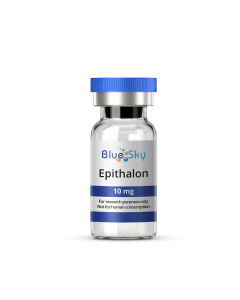
Buy Epithalon 10mg:
| Unit Size | 10 mg/vial |
| Unit Quantity | 1 vial |
| Purity (Mass Spectrometry and UV) | 93.13% |
| Sequence | H-Ala-Glu-Asp-Gly-OH |
| Molecular Formula | C14H22N4O9 |
| Appearance | Lyophilized White Powder |
| Source | Chemical Synthesis |
| Storage | Lyophilized Epithalon is stable at room temperature for 90 days; however, it is best stored in a freezer at -20°C for any extended period of time. |
| Terms | The products we offer are intended for laboratory research use only. Please familiarize yourself with our terms of service prior to ordering. |
| COA Verification | Verify this COA on MZ Biolabs → |
Epithalon Peptide 10mg
View Research Overview & References
Epithalon peptide is a synthetic peptide that mimics the naturally occurring protein epithalamin. Comprising four amino acids—alanine, glutamic acid, aspartic acid, and glycine—Epithalon (also known as epitalon) has a molecular mass of 390 g/mol. Known as the AEDG peptide, it is studied in vitro for its interactions with cell signaling and gene expression pathways.
Neurogenic Gene Expression Research in Stem Cells
In vitro studies using gingival mesenchymal stem cells found that the AEDG peptide increased mRNA expression of several neurogenic differentiation markers, including Nestin, GAP43, β-Tubulin III, and Doublecortin, by 1.6 to 1.8-fold in this cell-based system.
Molecular modeling in the same study indicated that the AEDG peptide preferentially binds specific sites on histones H1/6 and H1/3, suggesting a possible epigenetic mechanism for this cell-based gene expression effect.1
Cellular Senescence Research in Somatic Cells
In vitro studies have examined Epithalon's effects on fibroblast cell lines, with one study reporting that Epithalon-treated cells underwent a greater number of population doublings (over 44 passages) before reaching the Hayflick limit (the point at which cells enter senescence), compared to 34 passages for control cells.2
Separately, in vitro research examining somatic cells found that Epithalon treatment was associated with cells exceeding what researchers describe as their typical division limit.3
Peptide Structure and the AEDG Tetrapeptide Motif
Epithalon belongs to a broader class of short peptide bioregulators studied for tissue-specific gene regulation, a research area built around the premise that very short peptide sequences—often just two to four amino acids—can bind selectively to specific DNA regions and influence gene expression.
Within this class, Epithalon's four-residue AEDG sequence is notable for its high proportion of acidic residues (glutamic acid and aspartic acid), a compositional feature researchers have linked to the peptide's studied interactions with histone proteins and chromatin structures in laboratory models.
Analytical Purity Verification
Because Epithalon is a short, highly polar tetrapeptide, reversed-phase high-performance liquid chromatography (HPLC) methods used for purity assessment often require careful optimization of mobile phase conditions to achieve adequate retention and resolution, given the peptide's high water solubility relative to longer or more hydrophobic research peptides.
Mass spectrometry is used alongside HPLC to confirm sequence identity and detect synthesis-related impurities.
Storage and Handling in the Laboratory Setting
Short peptides with a high proportion of polar and acidic residues, such as Epithalon, can be more hygroscopic than larger or more hydrophobic peptides, making moisture control during storage a relevant consideration in the laboratory setting.
Standard practice involves storing lyophilized Epithalon in a sealed container under sub-zero freezer conditions, away from moisture and light.
Comparative Research Context Among Short Peptide Bioregulators
Epithalon is frequently studied alongside other short peptide bioregulators developed within the same research program, including a three-residue peptide investigated for retinal and cerebral tissue research and a two-residue peptide studied in the context of immune tissue signaling.
Researchers comparing these short bioregulator peptides have focused on how differences in amino acid composition and sequence length correspond to reported tissue-selective activity in laboratory models, using Epithalon's pineal-associated research profile as a reference point within this broader comparative framework.
Four Residues Changes What Can Go Wrong
Building a tetrapeptide requires only three coupling steps. That is close to the shortest a synthetic peptide gets, and it changes which impurities are plausible in the first place.
In a long sequence the dominant concern is deletion products: chains missing a residue because one coupling step ran incompletely. Across twenty-eight couplings there is ample opportunity for that to happen somewhere. Across three there is very little, and a deletion product would be a tripeptide differing from the target by an obvious margin rather than by a fraction of a percent.
What remains as a concern in a peptide this short is different in kind: incomplete removal of side-chain protecting groups, residual reagents carried through from cleavage, and the water and counterion that a hygroscopic material draws in. Those are the categories worth looking for on a certificate for a sequence of this length.
Three Carboxyl Groups on Four Residues
Glutamic acid and aspartic acid each carry a carboxyl group on their side chain, and the terminal glycine contributes a third as the free C-terminus. Against those three, the only basic group in the molecule is the N-terminal amine on alanine.
The result is a small molecule with an unusually high density of negative charge for its size, net around two minus at neutral pH. That accounts for the high water solubility noted above, and it is the direct cause of the chromatographic difficulty: reversed-phase columns retain molecules through hydrophobic interaction, and this sequence presents almost no hydrophobic surface to grip.
It is also why the peptide is discussed in connection with histones and chromatin. Strongly acidic short sequences interact readily with the basic residues that dominate histone proteins.
AEDG, Epithalon and Epitalon
Three names appear for this same compound, and each has a straightforward explanation.
AEDG is the sequence written in single-letter amino acid code: A for alanine, E for glutamic acid, D for aspartic acid, G for glycine. It carries exactly the same information as the sequence row above, in a more compact form.
Epithalon and Epitalon are two transliterations of the same Russian name, and both appear across the literature and in supplier catalogs, including on the certificate linked above. Neither spelling is more correct than the other. Anyone searching the literature is well advised to try both, and anyone matching material between suppliers should compare the four-residue sequence rather than the spelling.
Product Information
Epithalon is supplied as a lyophilized white powder in 10 mg vials.
Important Notice
This peptide is intended for laboratory research use (in vitro) only. It is not approved for human use. These findings do not establish safety, efficacy, or suitability for any human application outside of controlled research.
References
1. Khavinson V, Diomede F, Mironova E, Linkova N, Trofimova S, Trubiani O, Caputi S, Sinjari B. AEDG Peptide (Epitalon) Stimulates Gene Expression and Protein Synthesis during Neurogenesis: Possible Epigenetic Mechanism. Molecules. 2020 Jan 30;25(3):609.
2. Khavinson VK, Bondarev IE, Butyugov AA. Epithalon peptide induces telomerase activity and telomere elongation in human somatic cells. Bull Exp Biol Med. 2003 Jun;135(6):590-2.
3. Khavinson VK, Bondarev IE, Butyugov AA, Smirnova TD. Peptide promotes overcoming of the division limit in human somatic cells. Bull Exp Biol Med. 2004 May;137(5):503-6.
- Free Priority Shipping
- With Purchase over $75 | USA ONLY