CJC-1295 NO-DAC 2mg (MOD GRF 1-29)
Availability: In stock

- Free Priority Shipping
- With Purchase over $75 | USA ONLY



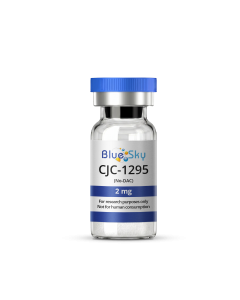
Buy 1 Get 1 Free CJC-1295 NO-DAC (MOD GRF 1-29) 2mg:
| Unit Size | 2 mg/vial |
| Unit Quantity | 1 vial |
| Purity (Mass Spectrometry and UV) | 99.18% |
| Sequence | H-Tyr-D-Ala-Asp-Ala-Ile-Phe-Thr-Gln-Ser-Tyr-Arg-Lys-Val-Leu-Ala- Gln-Leu-Ser-Ala-Arg-Lys-Leu-Leu-Gln-Asp-Ile-Leu-Ser-Arg-NH2 |
| Molecular Formula | C152H252N44O42 |
| Appearance | Lyophilized White Powder |
| Source | Chemical Synthesis |
| Storage | Lyophilized CJC-1295 NO-DAC is stable at room temperature for 90 days; however, it is best stored in a freezer at -20°C for any extended period of time. |
| Terms | The products we offer are intended for laboratory research use only. Please familiarize yourself with our terms of service prior to ordering. |
| COA Verification | Verify this COA on MZ Biolabs → |
CJC-1295 NO-DAC 2mg (MOD GRF 1-29)
View Research Overview & References
CJC-1295 NO-DAC is a synthetic peptide studied in vitro, featuring the first 29 amino acids of growth hormone-releasing hormone (GHRH), also called modified growth releasing factor 1-29 (MOD GRF 1-29). This peptide has a molecular weight of approximately 3.4 kDa.
GHRH Receptor Binding Research
Structural and computational modeling has characterized the GHRH receptor's dynamic conformational behavior, identifying the molecular determinants that govern ligand binding at this receptor and offering a mechanistic basis for how CJC-1295 NO-DAC's retained GHRH-derived sequence is positioned to engage it.1
Peptide Design: Four Stabilizing Substitutions to Native GRF
CJC-1295 NO-DAC carries four amino acid substitutions relative to the native 29-residue GRF sequence, each addressing a specific degradation pathway studied in peptide stability research.
The D-alanine substitution at position 2 is understood to block cleavage by dipeptidyl peptidase-IV, an enzyme that rapidly truncates native GRF at this position in biological systems. The glutamine substitution at position 8 is designed to prevent spontaneous deamidation of the native asparagine residue, a common degradation route for asparagine-containing peptides over time.
The alanine substitution at position 15 and the leucine substitution at position 27, which replaces a native methionine, are studied for reducing susceptibility to oxidation, since methionine residues are particularly prone to oxidative modification during storage and handling. Together, these four changes are the basis for the peptide's improved in vitro stability relative to unmodified GRF(1-29).
Analytical Purity Verification
As a 29-residue peptide, CJC-1295 NO-DAC presents more opportunities for synthesis-related impurities—such as deletion sequences or incomplete couplings—than shorter research peptides, making combined HPLC and mass spectrometry verification particularly important.
Researchers reviewing a certificate of analysis for this compound are encouraged to confirm both the overall purity percentage and the mass-spectrometric match to the full 29-residue sequence, since partial-length synthesis byproducts can be similar in mass to legitimate degradation products.
Storage and Handling in the Laboratory Setting
Despite its stabilizing substitutions, CJC-1295 NO-DAC is still a moderately large peptide susceptible to degradation under poor storage conditions.
Standard laboratory practice involves storing the lyophilized powder under sub-zero freezer conditions, since the intact 29-residue sequence is more vulnerable to hydrolysis and aggregation once the material is no longer in its stable, freeze-dried state.
Comparative Research Context Among GHRH Analogs
CJC-1295 NO-DAC is frequently discussed alongside other GHRH(1-29)-derived research peptides, including unmodified Sermorelin, which shares the same core sequence but lacks the four stabilizing substitutions described above and is correspondingly studied as having a much shorter half-life in vitro.
Researchers comparing these GHRH analogs have used differences in stability and receptor-binding duration to inform experimental design when a study calls for either transient or more sustained receptor occupancy in cell-based GHRH receptor assays.
The C-Terminal Amide
The sequence in the specification table ends in -NH2 rather than a free carboxyl group. That amide cap is carried over from native GRF, and it is built in during synthesis by choosing a resin that releases an amide on cleavage rather than an acid.
The consequence is one fewer negative charge at the end of the chain, and the loss of a site where a terminal carboxyl could otherwise participate in side reactions. An otherwise identical peptide ending in a free acid is a different compound, one dalton heavier, and mass spectrometry separates the two without difficulty.
Counting the Charged Residues
Five of the twenty-nine positions carry a basic side chain: arginine at 11, 20 and 29, and lysine at 12 and 21. Only two carry an acidic one, aspartate at 3 and 25.
That imbalance, together with the amidated C-terminus, leaves the peptide net positive at neutral pH, which accounts for much of its behavior as a readily water-soluble powder. The basic residues also fall into two adjacent pairs, Arg11-Lys12 and Arg20-Lys21, and consecutive basic residues are among the positions where stepwise coupling most often runs incompletely during synthesis.
Residue Classes the Sequence Does Not Contain
There is no cysteine anywhere in the chain, so the peptide forms no disulfide bonds and has no folding isomers to resolve. A single linear chain is the only form the synthesis can produce.
There is also no methionine, since the native residue at position 27 was replaced with leucine, and neither tryptophan nor histidine appears. The absence of all four removes the side chains most often implicated in oxidation during storage. That leaves tyrosine at positions 1 and 10 and phenylalanine at position 6 as the only aromatic residues, with the two tyrosines the main contributors to ultraviolet absorbance above 270 nm.
The Leucine-Rich Mid-Chain
From position 13 onward the sequence is dominated by leucine, alanine and glutamine, with leucine alone appearing five times between residues 14 and 27.
Residues of this kind carry a high intrinsic preference for alpha-helical geometry, and the corresponding region of native GRF is described in the structural literature as helical. A peptide of this length remains flexible in solution rather than rigidly folded, so the helical character is a propensity rather than a fixed structure, but it is a recognized feature of how this family of sequences is characterized.
Product Information
CJC-1295 NO-DAC is provided as a 2 mg lyophilized powder in a vial, intended strictly for in vitro laboratory research.
Important Notice
This product is strictly intended for in vitro laboratory research use only. It is not approved for any form of human consumption, diagnostic procedures, or medical treatment. Its use is restricted to controlled research environments, and these findings do not establish safety, efficacy, or suitability for any human application.
References
1. Matsoukas MT, Spyroulias GA. Dynamic properties of the growth hormone-releasing hormone receptor (GHRHR) and molecular determinants of GHRH binding. Mol Biosyst. 2017 Jun 27;13(7):1313-1322.
- Free Priority Shipping
- With Purchase over $75 | USA ONLY

-
 IPAMORELIN 2000mcgSpecial Price $16.78 Regular Price $41.95
-
 CJC-1295 W-DAC 2mgSpecial Price $19.98 Regular Price $49.95
-
-