GHRP-2 5mg
Availability: In stock

- Free Priority Shipping
- With Purchase over $75 | USA ONLY



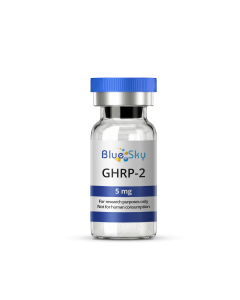
Buy 1 Get 1 Free - 5mg GHRP-2 Peptide:
| Unit Size | 5 mg/vial |
| Unit Quantity | 1 vial |
| Purity (Mass Spectrometry and UV) | 98.07% |
| Sequence | H-D-Ala-D-2-Nal-Ala-Trp-D-Phe-Lys-NH2 |
| Molecular Formula | C45H55N9O6 |
| Appearance | Lyophilized White Powder |
| Source | Chemical Synthesis |
| Storage | Lyophilized GHRP-2 is stable at room temperature for 90 days; however, it is best stored in a freezer at -20°C for any extended period of time. |
| Terms | The products we offer are intended for laboratory research use only. Please familiarize yourself with our terms of service prior to ordering. |
| COA Verification | Verify this COA on MZ Biolabs → |
GHRP-2 Peptide 5mg
View Research Overview
GHRP-2 (Pralmorelin) is a synthetic hexapeptide studied in laboratory research for its interaction with the growth hormone secretagogue receptor (GHS-R), the same receptor activated by the endogenous hormone ghrelin. This product is studied in vitro and is not intended for human or veterinary use.
Peptide Structure and the D-2-Naphthylalanine Substitution
GHRP-2's structure is closely related to GHRP-6, sharing the same D-Ala and D-Phe framework but substituting D-2-naphthylalanine (D-2-Nal) at the position occupied by D-tryptophan in GHRP-6. This substitution is of interest in structure-activity research because the bulkier naphthyl side chain is thought to improve hydrophobic contacts within the receptor's binding pocket relative to the indole ring of tryptophan.
This structural distinction is a frequent reference point in laboratory literature discussing binding characteristics across the GHRP-class secretagogues.
Comparative Structural Context Among GHRP-Class Secretagogues
GHRP-2 is one of several hexapeptide secretagogues sharing a related backbone, alongside GHRP-6 and hexarelin, that differ from one another primarily through substitutions at one or two positions in an otherwise conserved sequence.
- GHRP-6 uses D-tryptophan at the position where GHRP-2 uses D-2-naphthylalanine
- Hexarelin uses a methylated D-tryptophan variant at the same position
Researchers comparing these structurally similar peptides have focused on how such localized substitutions, rather than differences in peptide length or backbone chemistry, can meaningfully alter receptor engagement, illustrating a broader principle in short-peptide structure-activity research.
Receptor-Binding Assay Design in Cell-Based Systems
Laboratory research on GHS-R-targeting peptides such as GHRP-2 commonly relies on cell lines engineered to express the receptor of interest, allowing researchers to measure ligand binding and downstream signaling within a controlled cell culture system.
This approach isolates a single receptor's response from the many other signaling pathways present in a whole organism, and is a standard methodology for characterizing new GHS-R ligands at the cellular level.
Analytical Purity Verification
GHRP-2's bulky D-2-naphthylalanine residue introduces a specific synthesis risk that purity testing needs to account for: incomplete coupling at this bicyclic side chain during solid-phase synthesis.
Combined HPLC and mass spectrometry verification is used to detect this potential byproduct alongside standard sequence confirmation.
A certificate of analysis reporting purity consistent with the stated specification is generally regarded as the appropriate baseline for laboratory experiments requiring consistent receptor-binding behavior across replicate assays.
Storage and Handling in the Laboratory Setting
Lyophilized GHRP-2 is stored under sub-zero freezer conditions to preserve integrity between experimental sessions, with the powder kept away from prolonged light exposure, consistent with standard handling practices for aromatic-residue-containing research peptides.
Naphthalene Compared With Indole
Both tryptophan and 2-naphthylalanine carry a two-ring aromatic system, but the rings are not the same. Tryptophan's indole is a five-membered nitrogen-containing ring fused to a benzene ring. Naphthalene is two benzene rings fused together, with no heteroatom anywhere in the structure.
Three consequences follow from that difference. The naphthalene system is slightly larger and more uniformly hydrophobic across its surface. It carries no N-H group, so it cannot act as a hydrogen-bond donor the way indole can. And it lacks the electron-rich nitrogen position that makes indole the most readily oxidized of the common aromatic side chains.
That last point is why naphthylalanine is a common choice when a designer wants aromatic bulk without the chemical fragility that comes with tryptophan.
Pralmorelin and the Nonproprietary Naming System
Pralmorelin is this compound's international nonproprietary name, a designation assigned through the World Health Organization's INN programme to give each pharmacological substance one globally recognized generic name independent of any manufacturer.
INN names are built from standardized stems that signal a compound's class. The "-relin" ending seen here, and in ipamorelin, hexarelin, sermorelin, and tesamorelin, marks the group of peptides acting on pituitary hormone release. Recognizing that stem is a quick way to place an unfamiliar peptide name within a family.
Why Aromatic-Rich Sequences Report Different Purity Ranges
Purity figures are not directly comparable between peptides of different composition. A short sequence of small, unhindered residues couples cleanly at every step and routinely reports very high values. A sequence carrying several bulky aromatic groups does not have that advantage.
GHRP-2 contains three aromatic residues in six positions, one of them the oversized naphthylalanine. Each represents a coupling step with a higher chance of running incomplete, and each incomplete step leaves behind a closely related species that purification must then remove.
A purity figure for a sequence of this composition therefore reflects a harder synthesis, not a lower standard, and is best read against other aromatic-rich peptides rather than against the simplest sequences in a catalog.
Important Notice
GHRP-2 is provided strictly for laboratory research use only (in vitro) and is not approved for human or veterinary use. Any application outside of controlled research environments is strictly prohibited, and these findings do not establish safety, efficacy, or suitability for any human application.
Product Information
GHRP-2 is supplied as a lyophilized powder (5 mg per vial) exclusively for in vitro research use.
- Free Priority Shipping
- With Purchase over $75 | USA ONLY

-
-
-
 IPAMORELIN 2000mcgSpecial Price $16.78 Regular Price $41.95
-
 CJC-1295 NO-DAC 2mg (MOD GRF 1-29)Special Price $23.58 Regular Price $58.95