CJC-1295 W-DAC 2mg
Availability: In stock

- Free Priority Shipping
- With Purchase over $75 | USA ONLY



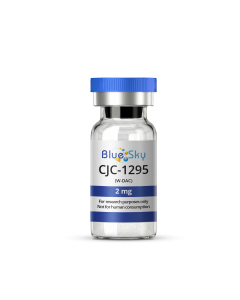
Buy CJC 1295 DAC 2mg:
| Unit Size | 2 mg/vial |
| Unit Quantity | 1 vial |
| Purity (Mass Spectrometry and UV) | 99.67% |
| Sequence | Tyr-D-Ala-Asp-Ala-Ile-Phe-Thr-Gln-Ser-Tyr-Arg-Lys-Val-Leu-Ala-Gln-Leu-Ser-Ala-Arg-Lys-Leu-Leu-Gln-Asp-Ile-Leu-Ser-Arg-Lys(Maleimidopropionyl)-NH2 |
| Molecular Formula | C165H269N47O46 |
| Appearance | Lyophilized White Powder |
| Source | Chemical Synthesis |
| Storage | Lyophilized CJC-1295 W-DAC is stable at room temperature for 90 days; however, it is best stored in a freezer at -20°C for any extended period of time. |
| Terms | The products we offer are intended for laboratory research use only. Please familiarize yourself with our terms of service prior to ordering. |
| COA Verification | Verify this COA on MZ Biolabs → |
CJC-1295 W-DAC 2mg
View Research Overview
CJC-1295 with DAC is a synthetic analog of growth hormone-releasing hormone (GHRH), studied in vitro to investigate GHRH receptor engagement. This peptide contains 30 amino acids and weighs approximately 3647 g/mol.
It was designed with a drug affinity complex (DAC) that binds to serum albumin, a structural modification studied for its relevance to extended stability profiles in laboratory research settings.
Peptide Design: The DAC Albumin-Binding Mechanism
The distinguishing structural feature of CJC-1295 with DAC is its terminal lysine residue, added beyond the native 29-residue GRF sequence, which is conjugated to a maleimidopropionyl group.
This maleimide chemistry is designed to form a covalent bond via Michael addition with the free thiol of cysteine-34 on serum albumin, the most abundant protein found in serum.
Researchers studying peptide-conjugation chemistry have examined this maleimide-cysteine coupling approach as one of several strategies for covalently linking a short peptide to a considerably larger carrier protein, in contrast to peptides like the unconjugated GRF(1-29) analog, which carries no such conjugation site and instead relies solely on internal sequence modifications for its more modest stability gains.
Analytical Verification of the DAC Conjugation Site
Because the maleimidopropionyl group is the functional basis for this peptide's albumin-binding capability, analytical verification for DAC-conjugated research peptides typically goes beyond standard sequence and purity confirmation to include mass-spectrometric confirmation that the maleimide group remains intact and unreacted prior to use.
A hydrolyzed or otherwise degraded maleimide group would compromise the peptide's albumin-binding capacity, and the resulting shift is small relative to the molecule's overall mass, making this an important additional consideration when reviewing a certificate of analysis for this specific compound.
Storage and Handling Considerations Specific to the Maleimide Group
The reactive maleimide group that defines this peptide's DAC functionality is sensitive to hydrolysis in aqueous environments, more so than the peptide backbone itself.
For this reason, the lyophilized powder is kept under sub-zero freezer conditions in sealed, moisture-limited packaging, since exposure to ambient humidity can gradually degrade the maleimide group even in the solid state.
Comparative Context: Conjugation Chemistry Approaches Among Research Peptides
Maleimide-based albumin conjugation is one of several protein-conjugation strategies studied in peptide chemistry, alongside approaches such as PEGylation and Fc-fusion, each of which uses a distinct chemical linkage to attach a peptide to a larger carrier molecule.
Researchers comparing these approaches have noted that maleimide-cysteine conjugation, as used in this compound, forms its covalent bond through a chemically distinct mechanism from PEGylation's polymer attachment chemistry or Fc-fusion's genetic fusion to an antibody fragment.
The Scale Difference Between Peptide and Carrier
Albumin is a 585-residue protein weighing roughly 66,500 g/mol. This peptide weighs about 3,647. The carrier is therefore some eighteen times the mass of what attaches to it.
That disparity is the point of the design, and it has a direct consequence for laboratory work. Once conjugation has occurred, the peptide is no longer a small molecule in any analytical sense: it travels as part of an assembly near 70,000 g/mol.
Size-based methods therefore behave entirely differently before and after conjugation. On size-exclusion chromatography or gel electrophoresis, free peptide and albumin-bound peptide separate dramatically rather than subtly, which is what makes conjugation straightforward to confirm in an assay system containing albumin.
What Maleimide Hydrolysis Looks Like in the Data
When water opens the maleimide ring, the reaction adds a molecule of water to the structure, raising the mass by approximately 18 units and converting the ring into an open-chain acid that no longer reacts with thiols.
Eighteen units is a clear signal in isolation, but against a parent mass near 3,647 it represents a shift of roughly half a percent. On a multiply charged spectrum that difference compresses further, so it is readily overlooked unless an analyst is specifically checking the intact-maleimide mass rather than confirming the compound in general terms.
This is the practical reason the certificate of analysis for a DAC-conjugated peptide warrants closer reading than one for an unmodified sequence.
Three Lysines, One of Them Blocked
The sequence contains three lysine residues, at positions 12, 21, and 30. The first two belong to the native GRF framework and retain free side-chain amines, each contributing a positive charge near neutral pH.
The third exists only to carry the conjugation handle. Its side-chain amine is acylated by the maleimidopropionyl group, so unlike its two counterparts it carries no free amine and no positive charge. Counting lysines in the sequence therefore overstates the molecule's basic character by one.
Alternate Names in the Literature
This compound appears in published work and supplier catalogs as CJC-1295 with DAC, CJC-1295 DAC, CJC-1295 W-DAC, and DAC:GRF, each referring to the same thirty-residue structure shown in the specification table above.
Important Notice
This CJC-1295 with DAC formulation is designed strictly for in vitro laboratory research only and is not intended for human use. Its use is limited to controlled laboratory environments for investigating cellular responses related to GH and IGF-1 pathways, and has not been evaluated for safety or efficacy in humans.
Product Information
CJC-1295 with DAC is provided as a lyophilized powder, intended strictly for in vitro laboratory research.
- Free Priority Shipping
- With Purchase over $75 | USA ONLY

-
 CJC-1295 NO-DAC 2mg (MOD GRF 1-29)Special Price $23.58 Regular Price $58.95
-
 IPAMORELIN 2000mcgSpecial Price $16.78 Regular Price $41.95
-
-