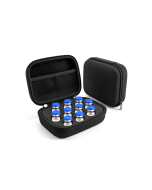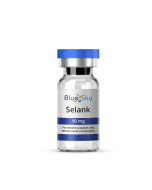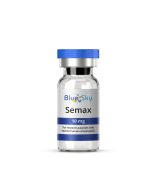
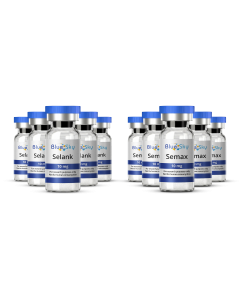
Bundle (Selank 10mg x5 + Semax 10mg x5)
Availability: In stock
- Selank 10mg: 5 Quantity
- Semax 10mg: 5 Quantity

- Free Priority Shipping
- With Purchase over $75 | USA ONLY



Selank 10mg:
| Unit Size | 10 mg/vial |
| Unit Quantity | 1 vial |
| Purity (Mass Spectrometry and UV) | 99.06% |
| Sequence | H-Thr-Lys-Pro-Arg-Pro-Gly-Pro-OH |
| Molecular Formula | C33H57N11O9 |
| Appearance | Lyophilized White Powder |
| Source | Chemical Synthesis |
| Storage | Lyophilized Selank is stable at room temperature for 90 days; however, it is best stored in a freezer at -20°C for any extended period of time. |
| Terms | The products we offer are intended for laboratory research use only. Please familiarize yourself with our terms of service prior to ordering. |
| COA Verification | Verify this COA on MZ Biolabs → |
Semax 10mg:
| Unit Size | 10 mg/vial |
| Unit Quantity | 1 vial |
| Purity (Mass Spectrometry and UV) | 99.67% |
| Sequence | H-Met-Glu-His-Phe-Pro-Gly-Pro-OH |
| Molecular Formula | C37H51N9O10S |
| Appearance | Lyophilized White Powder |
| Source | Chemical Synthesis |
| Storage | Lyophilized Semax is stable at room temperature for 90 days; however, it is best stored in a freezer at -20°C for any extended period of time. |
| Terms | The products we offer are intended for laboratory research use only. Please familiarize yourself with our terms of service prior to ordering. |
| COA Verification | Verify this COA on MZ Biolabs → |
Bundle (Selank 10mg x5 + Semax 10mg x5)
View Research Overview & References
This bundle pairs five 10mg vials of Selank with five 10mg vials of Semax. Both are synthetic heptapeptides derived from larger parent peptides, and both carry a C-terminal proline-glycine-proline (Pro-Gly-Pro) motif, which makes the pair a useful side-by-side study in peptide chemistry.
Despite that shared design feature, the two originate from completely different parent sequences, giving each its own charge, chemistry and analytical profile.
Shared Design, Different Origins
- Selank: Thr-Lys-Pro-Arg-Pro-Gly-Pro, about 752 g/mol. It is a synthetic analog of the naturally occurring peptide tuftsin (Thr-Lys-Pro-Arg), with the Pro-Gly-Pro motif appended.
- Semax: Met-Glu-His-Phe-Pro-Gly-Pro, about 814 g/mol. It is derived from the 4–10 fragment of adrenocorticotropic hormone (ACTH), a melanocortin-family peptide, likewise extended with Pro-Gly-Pro.
Both are built on the same principle: take a short bioactive parent sequence and append a glyproline fragment to improve its resistance to enzymatic breakdown. Studying them together isolates how that shared stabilizing motif behaves against two different peptide backbones.
The Pro-Gly-Pro Stabilizing Motif
Proline is the one standard amino acid whose side chain loops back onto its own backbone nitrogen, forming a ring that rigidifies the peptide bond and blocks many proteases that require a flexible, extended substrate.
In a Pro-Gly-Pro arrangement, two prolines flank a small, flexible glycine. This gives the C-terminus both conformational constraint and resistance to the exopeptidases that would otherwise trim a peptide from its C-terminal end.
Because Selank and Semax share this exact motif but differ everywhere else, the pair is a clean illustration of how a single stabilizing element carries across to peptides of very different composition.
Selank: Chemistry and Charge
Selank is strongly basic. It carries a lysine and an arginine, plus a free N-terminal amine, against no acidic residues, giving it a high net positive charge at neutral pH.
In practice this means excellent solubility in water and dilute acidic solutions. Like other highly basic peptides, it can adsorb to glass and some plastics at low concentration, so low-binding labware or a carrier protein helps preserve working concentration.
Selank contains no methionine, cysteine, tryptophan or tyrosine, so it has neither a notable oxidation liability nor meaningful UV absorbance at 280 nm. Its proline-rich composition makes it chemically robust overall.
Semax: Chemistry and the Melanocortin Connection
Semax is more chemically varied. Its N-terminal methionine is an oxidation site, converting to methionine sulfoxide (+16 Da) under air, light or trace metals, and its histidine can take part in metal-catalyzed oxidation.
Because its N-terminal segment comes from ACTH, Semax belongs chemically to the melanocortin ligand family, which binds class A GPCRs (MC1R–MC5R) that couple to Gαs and raise cyclic AMP. The conserved melanocortin recognition element is a His-Phe-Arg-Trp sequence; Semax retains the His-Phe portion but not the full motif.
Structural studies of this receptor family provide the reference framework for melanocortin-ligand work. A cryo-EM structure of the melanocortin-4 receptor (MC4R) bound to a peptide agonist and Gs has mapped the binding pocket [1], and an earlier MC4R structure identified a calcium ion bound jointly to the receptor and ligand, with extracellular Ca2+ markedly increasing agonist affinity [2].
Running Assays on the Pair
The two peptides are generally studied in separate systems, because their relevant targets differ:
- Semax: profiled against melanocortin receptors in receptor-expressing cell lines, usually by cAMP accumulation or competition binding, with calcium concentration held constant and reported, since extracellular Ca2+ participates directly in melanocortin ligand binding.
- Selank: studied in cell-based systems rather than against a single defined receptor, commonly through gene-expression readouts in cultured neuronal cell lines, since no one receptor target is as firmly established for it as the melanocortin receptors are for Semax.
For this reason the two are rarely run in the same assay. The comparison researchers draw between them is usually a chemical one, concerning how the shared Pro-Gly-Pro motif performs on two different backbones, rather than a head-to-head measurement of activity within a single system.
Equal Masses, Nearly Equal Moles
This bundle supplies 10 mg of each peptide, and in this particular pair those equal masses also translate into nearly equal numbers of molecules.
Selank is about 752 g/mol and Semax about 814, a difference of only eight percent. Dividing 10 mg by each figure gives roughly 13.3 micromoles of Selank against 12.3 micromoles of Semax.
That near-equivalence is worth noting precisely because it does not hold for most paired products. Where two peptides differ substantially in molecular weight, equal masses deliver very different molar quantities. Here the two heptapeptides are close enough in size that a gravimetric comparison and a molar one lead to much the same place.
Storage and Handling Across the Bundle
Both peptides are stored lyophilized under sub-zero freezer conditions, and across ten vials the difference in chemistry between the two matters more than it would for a single purchase.
Selank is the more robust of the pair. With no methionine, cysteine, tryptophan or tyrosine anywhere in its sequence, it has no readily oxidized side chain to protect.
Semax does have one, in the methionine at its first position, so its vials warrant more care over light exposure and prolonged time at room temperature than Selank's do. Keeping the two sets separated in storage rather than mixed together in one box makes that distinction easier to maintain in practice.
Important Notice
Selank and Semax are strictly intended for in vitro laboratory research use only. Neither is approved for any form of human consumption, diagnostic procedures, or medical treatment. Their use is restricted to controlled research environments, and these findings do not establish safety, efficacy, or suitability for any human application.
Product Information
This bundle includes 5 vials of Selank at 10 mg per vial and 5 vials of Semax at 10 mg per vial, supplied as lyophilized powders strictly for in vitro laboratory research.
References
- Heyder NA, Kleinau G, Speck D, et al. Structures of active melanocortin-4 receptor–Gs-protein complexes with NDP-α-MSH and setmelanotide. Cell Res. 2021;31(11):1176-1189.
- Yu J, Gimenez LE, Hernandez CC, et al. Determination of the melanocortin-4 receptor structure identifies Ca2+ as a cofactor for ligand binding. Science. 2020;368(6489):428-433.
- Free Priority Shipping
- With Purchase over $75 | USA ONLY