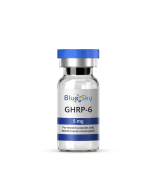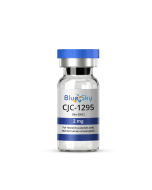
Blend CJC 1295 NO DAC 5mg with GHRP-6 5mg
Availability: In stock

- Free Priority Shipping
- With Purchase over $75 | USA ONLY



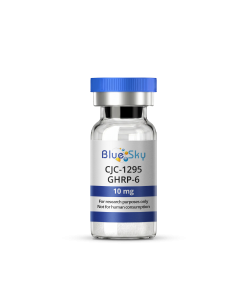
Buy 2 Get 1 Free Blend CJC 1295 NO DAC 5mg with GHRP-6 5mg:
| Unit Size | 10 mg/vial |
| Unit Quantity | 1 vial |
| Purity (Mass Spectrometry and UV) | 99.38% Nominal Target: 5 mg CJC 1295 NO DAC + 5 mg GHRP-6 |
| Sequence (CJC 1295 NO DAC) | H-Tyr-D-Ala-Asp-Ala-Ile-Phe-Thr-Gln-Ser-Tyr-Arg-Lys-Val-Leu-Ala-Gln-Leu-Ser-Ala-Arg-Lys-Leu-Leu-Gln-Asp-Ile-Leu-Ser-Arg-NH2 |
| Sequence (GHRP 6) | H-His-D-Trp-Ala-Trp-D-Phe-Lys-NH2 |
| Molecular Formula (CJC 1295 NO DAC) |
C152H252N44O42 |
| Molecular Formula (GHRP 6) | C46H56N12O6 |
| Appearance | Lyophilized White Powder |
| Source | Chemical Synthesis |
| Storage | Lyophilized Blend CJC 1295 NO DAC with GHRP-6 is stable at room temperature for 90 days; however, it is best stored in a freezer at -20°C for any extended period of time. |
| Terms | The products we offer are intended for laboratory research use only. Please familiarize yourself with our terms of service prior to ordering. |
| COA Verification | Verify this COA on MZ Biolabs → |
Blend CJC-1295 NO-DAC 5mg with GHRP-6 5mg
View Research Overview & References
This blend combines CJC-1295 NO-DAC, a 29-residue analog of growth hormone-releasing hormone (GHRH), with GHRP-6, a synthetic hexapeptide that engages the growth hormone secretagogue receptor (GHS-R). The two peptides are studied together in vitro because they act on separate, complementary receptor pathways.
GHRH Receptor Engagement Research
Structural and computational research has characterized the dynamic properties of the GHRH receptor and the molecular determinants involved in GHRH binding, offering a receptor-level basis for understanding how CJC-1295 NO-DAC's retained GHRH-derived sequence is positioned to engage this receptor in laboratory studies.1
CJC-1295 NO-DAC Stabilizing Substitutions
CJC-1295 NO-DAC carries four amino acid substitutions relative to native GRF(1-29), each addressing a distinct degradation pathway: D-alanine at position 2 blocks cleavage by dipeptidyl peptidase-IV, glutamine at position 8 prevents deamidation, and alanine at position 15 together with a leucine substitution at position 27 reduce susceptibility to oxidation.
These four changes are the structural basis researchers cite for the peptide's improved in vitro stability relative to unmodified GRF(1-29).
GHRP-6 Structural Considerations
GHRP-6's sequence includes two D-amino acid residues, D-tryptophan and D-phenylalanine, positioned at sites that would otherwise be highly susceptible to exopeptidase cleavage.
Researchers studying secretagogue peptide design have noted that this D-amino acid substitution pattern is a common strategy for conferring resistance to the L-amino-acid-specific proteolytic enzymes that would otherwise rapidly degrade an all-L-sequence peptide of comparable length.
Combined Research Applications
Because CJC-1295 NO-DAC and GHRP-6 engage separate receptors, this blend is studied for research examining potential convergence of GHRH-receptor and GHS-R signaling pathways within a single controlled experimental platform.
Combined use of these peptides remains an area of exploratory laboratory research, and available data on interaction effects between the two components is preliminary and not considered conclusive.
Analytical Verification for Blended Products
For a two-component blend combining a 29-residue peptide with a considerably shorter hexapeptide, analytical verification is understood to require confirmation of both components' individual identity and purity, along with the ratio between them.
Researchers reviewing documentation for this blend are encouraged to look for individual HPLC or mass spectrometry data for CJC-1295 NO-DAC and GHRP-6 separately.
Storage and Handling in the Laboratory Setting
CJC-1295 NO-DAC's longer chain length and GHRP-6's dual tryptophan-derived residues each introduce their own routes of degradation, making the blend's more conservative handling requirement the relevant standard for the combined vial.
The lyophilized blend is stored under sub-zero freezer conditions, with the powder kept away from prolonged light exposure given GHRP-6's photosensitive tryptophan content.
A Blend Is a Physical Mixture, Not a Conjugate
The two peptides in this vial are separate molecules. They are not joined by any covalent bond, and neither one is modified to accommodate the other. The vial holds material co-lyophilized from a solution containing both, so each peptide retains exactly the sequence, formula and mass listed in its own row above.
That distinction matters when reading analytical data. A conjugate of these two sequences would appear as a single species of combined mass. A blend appears as two independent species, and two independent species are what documentation for this product should show.
Two Tryptophans Weight the Ultraviolet Trace
GHRP-6 carries tryptophan at positions 2 and 4. CJC-1295 NO-DAC carries none, having two tyrosines and one phenylalanine as its only aromatic residues.
Tryptophan absorbs considerably more strongly near 280 nm than tyrosine does, so at that wavelength the hexapeptide produces a signal out of proportion to its share of the mass in the vial. Reading peak areas at 280 nm alone would misrepresent the mixture. Detection in the 214 to 220 nm range, where absorbance arises from the peptide backbone rather than from side chains, gives a response much closer to proportional for both components.
Why the Two Components Separate Cleanly
These two peptides are straightforward to resolve by reverse-phase chromatography, and for reasons that go beyond the difference in their length.
GHRP-6 is unusually hydrophobic for a six-residue peptide, with two indole rings and a benzyl side chain packed into a short chain. CJC-1295 NO-DAC runs in the opposite direction, being net positive, rich in hydroxyl-bearing residues and strongly water-soluble. The two therefore elute well apart from one another, which is what makes component-by-component verification of a blend like this practical rather than an estimate.
Purity and Ratio Are Separate Specifications
The specification table lists both a purity figure and a nominal 5 mg plus 5 mg target. These answer different questions and are measured in different ways.
Purity describes what fraction of the material in the vial is the two intended peptides rather than synthesis byproducts, residual salts or solvent. The ratio describes how that intended material divides between the two components. A vial can meet its purity specification and still sit slightly off its nominal split, which is why documentation for a blended product is read on both counts rather than on purity alone.
Important Notice
This product is strictly intended for in vitro laboratory research and is not for human consumption, diagnostic use, or therapeutic purposes. This product has not been evaluated for safety or efficacy in humans. Researchers utilize this product to investigate growth hormone-related receptor signaling mechanisms in experimental settings.
Product Information
This peptide combination is supplied as a lyophilized powder, 10 mg per vial (5 mg of each peptide).
References
1. Matsoukas MT, Spyroulias GA. Dynamic properties of the growth hormone-releasing hormone receptor (GHRHR) and molecular determinants of GHRH binding. Mol Biosyst. 2017;13(7):1313-1322.
- Free Priority Shipping
- With Purchase over $75 | USA ONLY

-
 CJC-1295 NO-DAC 2mg (MOD GRF 1-29)Special Price $23.58 Regular Price $58.95
-