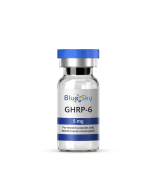
Buy Bulk GHRP-6 5mg
Availability: In stock
- Buy 50 for $14.95 each and save 68%
- Buy 100 for $12.95 each and save 72%
- Buy 200 for $11.95 each and save 74%

- Free Priority Shipping
- With Purchase over $75 | USA ONLY


Buy Bulk GHRP-6 5mg (No Promo Codes):
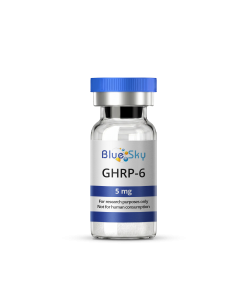
| Unit Size | 5 mg/vial |
| Unit Quantity | 1 vial |
| Purity (Mass Spectrometry and UV) | 98.59% |
| Sequence | His-D-Trp-Ala-Trp-D-Phe-Lys-NH2 |
| Molecular Formula | C46H56N12O6 |
| Appearance | Lyophilized White Powder |
| Source | Chemical Synthesis |
| Storage | Lyophilized GHRP-6 is stable at room temperature for 90 days; however, it is best stored in a freezer at -20°C for any extended period of time. |
| Terms | The products we offer are intended for laboratory research use only. Please familiarize yourself with our terms of service prior to ordering. |
| COA Verification | Verify this COA on MZ Biolabs → |
GHRP-6 5mg (Bulk)
View Research Overview
GHRP-6 is a synthetic hexapeptide studied in vitro for its interaction with the growth hormone secretagogue receptor (GHS-R), despite having no structural similarity to the endogenous hormone ghrelin that naturally activates this receptor.
Agonist and Antagonist Variants of the Same Scaffold
Beyond the parent GHRP-6 sequence, researchers have developed structural variants of this scaffold with opposing receptor pharmacology, most notably [D-Lys-3]-GHRP-6, which functions as a GHS-R antagonist rather than an agonist.
This agonist-antagonist pairing built on a shared six-residue backbone is a useful research tool for isolating GHS-R-specific effects in cell-based signaling assays, since researchers can compare responses with the receptor activated versus blocked using structurally related compounds.
Tryptophan Content and Photosensitivity
GHRP-6 contains two tryptophan-derived residues, one in the L-configuration and one in the D-configuration, giving it a higher aromatic indole content than related secretagogues such as GHRP-2.
This dual-tryptophan composition provides a strong UV chromophore useful for spectroscopic detection during purity work, but also makes the peptide more susceptible to photodegradation than secretagogues with fewer tryptophan residues.
Analytical Purity Verification for Bulk Quantities
Deletion and truncation byproducts are a particular concern during solid-phase synthesis of this peptide, since its two bulky aromatic tryptophan residues are more prone to incomplete coupling than smaller side chains.
For bulk orders, researchers are encouraged to confirm that HPLC and mass spectrometry data reflects the specific production batch supplied, given the added synthesis complexity these residues introduce.
Storage and Handling in the Laboratory Setting
Lyophilized GHRP-6 is stored under sub-zero freezer conditions, with the powder kept away from direct light given its tryptophan-driven photosensitivity.
Given the added light sensitivity, laboratories receiving bulk shipments commonly transfer stock into several smaller, opaque or foil-wrapped containers at intake, rather than repeatedly opening one larger container over the course of a study.
Residue-by-Residue Structure
Each position in the GHRP-6 chain contributes a distinct chemical feature to the overall molecule:
- Position 1, Histidine: an imidazole side chain that is partially protonated near neutral pH
- Position 2, D-Tryptophan: a non-natural D-configured aromatic residue
- Position 3, Alanine: a small methyl side chain, and the site modified in the [D-Lys-3] antagonist variant
- Position 4, Tryptophan: the second indole-bearing residue, in the natural L-configuration
- Position 5, D-Phenylalanine: a second D-configured aromatic residue
- Position 6, Lysine amide: a basic side chain with a C-terminal amide in place of a free carboxyl group
The two D-amino acids reduce recognition by common proteases in cell-based systems, while the C-terminal amide removes a negative charge, leaving the peptide with a net positive charge at physiological pH.
Origins of the Growth Hormone Releasing Peptide Series
GHRP-6 emerged from structure-activity work on small synthetic peptides in the late 1970s and early 1980s. It was characterized years before its target receptor was cloned in 1996 and before ghrelin was identified as that receptor's natural ligand in 1999.
This sequence of discoveries is why GHRP-6 is often described as a tool compound that helped lead researchers to the receptor itself, rather than one designed to mimic a known hormone.
Receptor Signaling Studied in Cell-Based Assays
GHS-R1a, the receptor subtype most often examined with GHRP-6, is a G protein-coupled receptor that signals primarily through the Gq/11 pathway. Activation of this pathway stimulates phospholipase C, generating inositol phosphates and releasing calcium from intracellular stores.
Laboratories commonly measure these events using calcium flux readouts, inositol monophosphate accumulation assays, or reporter gene constructs in transfected cell lines expressing the receptor.
Stereochemistry and Chiral Purity
Because GHRP-6 contains two D-amino acids, its identity depends on stereochemistry as well as sequence. A version with an L-residue in place of either D-residue would have the same mass and formula, so standard mass spectrometry alone cannot tell them apart.
Chiral amino acid analysis, or HPLC methods able to separate diastereomers, can confirm that each residue carries the intended configuration.
Oxidation Monitoring in Stored Material
Tryptophan oxidation typically appears in mass spectrometry data as additional peaks about 16 Da heavier than the parent mass, making MS a practical way to check stored bulk material for degradation over time.
Lot Tracking for Multi-Vial Studies
When a single study draws on several vials from a bulk order, recording the lot number used in each experiment simplifies later data review. Keeping the matching certificate of analysis on file alongside experimental records also supports reproducibility if results need to be compared across batches.
Common Names and Identifiers
This compound appears in literature and catalogs as GHRP-6, GHRP 6, Growth Hormone Releasing Peptide-6, and Growth Hormone Releasing Hexapeptide. Each name refers to the same six-residue sequence shown in the specification table above.
Important Notice
GHRP-6 is intended exclusively for laboratory research use (in vitro) and is not approved for human use. This product has not been evaluated for safety or efficacy in humans, and these findings do not establish safety or efficacy for any human application.
Product Information
GHRP-6 is available as a lyophilized white powder, available in bulk quantity.
- Free Priority Shipping
- With Purchase over $75 | USA ONLY

-
-
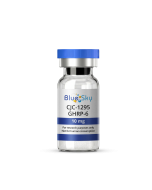 Blend CJC 1295 NO DAC 5mg with GHRP-6 5mgSpecial Price $39.98 Regular Price $99.95