MELANOTAN II 10mg
Availability: In stock

- Free Priority Shipping
- With Purchase over $75 | USA ONLY



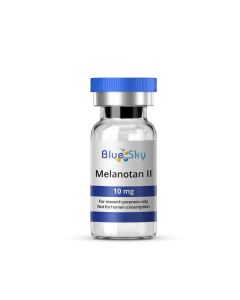
Buy Melanotan II 10mg :
| Unit Size | 10 mg/vial |
| Unit Quantity | 1 vial |
| Purity (Mass Spectrometry and UV) | 99.51% |
| Sequence | Ac-Nle-Asp-His-D-Phe-Arg-Trp-Lys-NH2 |
| Molecular Formula | C50H69N15O9 |
| Appearance | Lyophilized White Powder |
| Source | Chemical Synthesis |
| Storage | Lyophilized Melanotan II is stable at room temperature for 90 days; however, it is best stored in a freezer at -20°C for any extended period of time. |
| Terms | The products we offer are intended for laboratory research use only. Please familiarize yourself with our terms of service prior to ordering. |
| COA Verification | Verify this COA on MZ Biolabs → |
MELANOTAN II 10mg
View Research Overview & References
Melanotan II is a synthetic analog of alpha-melanocyte-stimulating hormone (α-MSH), studied in vitro as an agonist at melanocortin receptors, including MC1R, a melanocortin receptor subtype.
MC1R Binding and cAMP Signaling Research
In a cell-based assay using the cloned MC1R receptor, Melanotan II bound the receptor with an IC50 of approximately 0.57 nM and stimulated intracellular cAMP with an EC50 of approximately 0.20 nM.1
Under the same conditions, native α-MSH was roughly tenfold less potent in both measures, placing Melanotan II among the more potent synthetic MC1R agonists characterized in this receptor system.1
Peptide Design and Structural Modifications
Melanotan II is distinguished from native α-MSH by several deliberate structural modifications studied in peptide chemistry research.
A norleucine (Nle) substitution at the position corresponding to methionine in the native hormone removes a residue prone to oxidative degradation, a common concern when working with methionine-containing peptides in laboratory settings.
The peptide is also cyclized through a lactam bridge linking the Asp and Lys side chains, a modification studied for its effect on constraining the peptide's conformation and increasing resistance to enzymatic breakdown relative to linear melanocortin fragments.
The inclusion of a D-phenylalanine residue in place of the corresponding L-amino acid is another feature researchers examine when comparing metabolic stability across melanocortin receptor agonists used in in vitro assay systems.
Analytical Purity Verification
Purity testing for Melanotan II research material typically combines high-performance liquid chromatography (HPLC) with mass spectrometry to confirm both the cyclized structure and the absence of linear (non-cyclized) synthesis byproducts, which can co-occur during lactam bridge formation.
Because the cyclization step introduces additional complexity relative to linear peptide synthesis, researchers often place particular emphasis on confirming ring closure via mass confirmation rather than relying on HPLC retention time alone.
Storage and Handling in the Laboratory Setting
Melanotan II is best preserved in its freeze-dried state under sub-zero freezer storage when not in active use, since the lactam-cyclized structure, while more stable than a linear analog, remains susceptible to degradation once exposed to moisture or ambient conditions.
Laboratories typically limit the powder's exposure to light and room temperature, both of which are known to accelerate peptide degradation.
Comparative Research Context Among Melanocortin Agonists
Melanotan II is frequently referenced in laboratory literature alongside other melanocortin receptor agonists, including NDP-α-MSH, as researchers compare receptor selectivity and binding kinetics across this peptide class.
Its non-selective activity across multiple melanocortin receptor subtypes distinguishes it from more selective agonists developed later through targeted structure-activity relationship studies, a distinction commonly cited when researchers select a melanocortin tool compound for a specific receptor-subtype assay design.
The Conserved Core at Positions 3 to 6
Reading the sequence in the specification table, positions three through six spell His-D-Phe-Arg-Trp. That four-residue stretch is the conserved core shared across the melanocortin peptide family, and it is the segment most closely associated with receptor recognition in structure-activity research.
Native α-MSH carries the same four residues, in the L-configuration, at positions six through nine of its thirteen-residue chain. Melanotan II reproduces that core and discards most of the surrounding sequence, which is why a seven-residue peptide can engage the same receptors as a thirteen-residue hormone.
Confirming those four positions is a quick way to verify that a sequence belongs to this family rather than relying on the product name.
Reading the Potency Figures
The two numbers cited above measure different things, which is why both are reported.
An IC50 comes from a binding assay. It is the concentration at which the test compound displaces half of a labeled reference ligand from the receptor, and it describes how tightly the compound attaches.
An EC50 comes from a functional assay. It is the concentration producing half the maximum measurable response, in this case cAMP accumulation inside the cell, and it describes what happens after binding occurs.
Both figures here sit below one nanomolar, meaning fewer than one billionth of a mole per litre produces the stated effect. Reporting both matters because a compound can bind tightly without fully activating a receptor, and the pair of numbers together distinguishes an agonist from a binder.
One Tryptophan and UV Detection
The tryptophan at position six is the only residue in this sequence carrying an indole ring, and it gives the molecule a strong ultraviolet absorbance near 280 nanometres.
That provides a convenient secondary detection handle during chromatographic analysis, alongside the 214 to 220 nanometre range where the peptide bonds themselves absorb. It is also the residue behind the light sensitivity noted in the handling section above.
Alternate Names in the Literature
This peptide appears in published work and supplier catalogs as Melanotan II, Melanotan-2, MT-II, and MT-2. Each refers to the same cyclic seven-residue structure shown in the specification table above.
Important Notice
Melanotan II is intended exclusively for laboratory research use (in vitro) and is not approved for human use, diagnostics, or therapeutic applications. Any application outside of controlled research settings is prohibited, and these findings do not establish safety, efficacy, or suitability for any human application.
References
1. Haskell-Luevano C, Miwa H, Dickinson C, Hruby VJ, Yamada T, Gantz I. Binding and cAMP Studies of Melanotropin Peptides with the Cloned Human Peripheral Melanocortin Receptor, hMC1R. Biochem Biophys Res Commun. 1994;204(3):1137-1142.
- Free Priority Shipping
- With Purchase over $75 | USA ONLY

-
 PT-141 (Bremelanotide) 10mgSpecial Price $21.98 Regular Price $54.95
-
-
-