IGF-1 LR3 1mg
Availability: In stock

- Free Priority Shipping
- With Purchase over $75 | USA ONLY



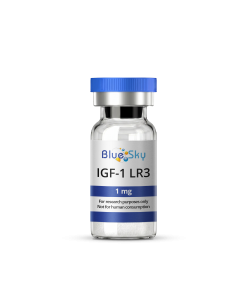
Buy Premium IGF-1 LR3 1mg :
| Unit Size | 1 mg/vial |
| Unit Quantity | 1 vial |
| Purity (Mass Spectrometry and UV) | 99.02% |
| Sequence | MFPAMPLSSL FVNGPRTLCG AELVDALQFV CGDRGFYFNK PTGYGSSSRR APQTGIVDEC CFRSCDLRRL EMYCAPLKPA KSA |
| Molecular Formula | C400H625N111O115S9 |
| Appearance | Lyophilized White Powder |
| Source | Recombinant Synthesis |
| Storage | Lyophilized IGF-1 LR3 is stable at room temperature for 90 days; however, it is best stored in a freezer at -20°C for any extended period of time. |
| Terms | The products we offer are intended for laboratory research use only. Please familiarize yourself with our terms of service prior to ordering. |
| COA Verification | Verify this COA on Freedom Diagnostics → |
IGF-1 LR3 1mg
View Research Overview & References
IGF-1 LR3 is a synthetic peptide studied in in vitro laboratory research. Structurally similar to insulin-like growth factor 1 (IGF-1), IGF-1 LR3 features specific modifications that alter its interaction with IGF-binding proteins (IGFBPs).
This variant has an extended peptide sequence and replaces glutamic acid with arginine at the third position (R3), adding 13 amino acids to the N-terminus for a total of 83 amino acids compared to the 70 amino acids in standard IGF-1. This product is studied in vitro and is not intended for human use or consumption.
IGF-Binding Protein Interaction Research
IGFBPs are a family of six proteins that regulate IGF-1 activity through both IGF-dependent mechanisms, such as controlling how much IGF-1 is available to bind cell-surface receptors, and IGF-independent mechanisms involving direct interactions at the cell surface or intracellularly.1
IGF-1 LR3's reduced affinity for several IGFBP family members, attributed to its N-terminal extension and arginine substitution, is the basis researchers cite for its increased availability to interact directly with IGF-1 receptors in cell-based laboratory assays, relative to native IGF-1.
Structural Basis for Reduced IGFBP Binding
The arginine substitution at position 3 sits within a region of the IGF-1 molecule that native IGFBPs use as part of their binding interface, and researchers studying this substitution have linked the resulting charge and side-chain change to a substantially reduced binding affinity for several IGFBP family members.
Combined with the 13-residue N-terminal extension, which is also thought to sterically interfere with IGFBP engagement, this dual modification is the basis researchers cite for why IGF-1 LR3 remains more available to bind IGF-1 receptors directly in laboratory assay systems compared to native IGF-1.
Analytical Verification for Recombinant Proteins
As a full-length 83-residue recombinant protein rather than a short synthetic peptide, IGF-1 LR3 requires analytical methods suited to larger biomolecules, including SDS-PAGE or size-exclusion chromatography to confirm molecular size and the absence of aggregation or degradation products, alongside mass spectrometry for identity confirmation.
Storage and Handling in the Laboratory Setting
Lyophilized IGF-1 LR3 is stored under sub-zero freezer conditions to preserve structural integrity.
Larger recombinant proteins are also more sensitive than short synthetic peptides to repeated temperature cycling, since the folded structure can begin to loosen across many warming and cooling events even while the material remains in its dry state.
Comparative Research Context Among IGF-1 Analogs
IGF-1 LR3 is frequently studied alongside other reduced-IGFBP-affinity analogs, including des(1-3)IGF-1, which achieves a similar reduction in IGFBP binding through N-terminal truncation rather than extension.
Researchers comparing these analogs to native IGF-1 in in vitro laboratory studies have used differences in IGFBP affinity across the three molecules to isolate IGF-1-receptor-mediated effects from the modulating influence of IGFBPs in cell-based assay systems.
Two Routes to the Same Position
The comparison with des(1-3)IGF-1 is worth drawing out, because the two analogs arrive at reduced IGFBP affinity by opposite means, and both act on the same three residues.
Native IGF-1 opens with glycine, proline and glutamic acid. In des(1-3)IGF-1 those first three residues are removed entirely, taking the glutamate with them. In IGF-1 LR3 the chain is extended rather than shortened, and the glutamate at position 3 is replaced by arginine.
One approach deletes the acidic residue, the other substitutes a basic one in its place. That both strategies reduce IGFBP binding points to the same conclusion: the glutamate at position 3 is a meaningful part of how binding proteins recognize the molecule.
Size Relative to the Rest of the Catalog
At 83 residues and a molecular weight near 9,100, this is by a wide margin the largest molecule among the research peptides listed here. A short peptide such as a tripeptide sits near 340; most mid-sized sequences fall between 1,000 and 5,000.
That difference changes which analytical techniques apply. On SDS-PAGE this protein runs as a visible band near the 10 kDa marker, a measurement that simply does not work for peptides below roughly 3 kDa, and size-exclusion chromatography becomes informative in a way it is not for smaller molecules.
The Six Binding Proteins
The IGFBP family is numbered IGFBP-1 through IGFBP-6. All six bind IGF-1, but they differ in where they are expressed, in their relative affinities, and in whether they carry additional activities independent of IGF binding.
This is why reduced-affinity analogs are described as having lower affinity for several family members rather than for all six uniformly, and why experimental systems containing different binding proteins can give different results with the same analog.
Alternate Names in the Literature
This protein appears in published work and supplier catalogs as IGF-1 LR3, Long R3 IGF-1, LR3 IGF-1, and Long Arg3 Insulin-like Growth Factor-1. Each refers to the same 83-residue sequence shown in the specification table above.
Important Compliance Notice
IGF-1 LR3 is intended for laboratory research use only (in vitro) and is not approved for human, therapeutic, or diagnostic use. Any application outside controlled in vitro research environments is prohibited. Laboratory safety protocols should be followed when handling this peptide to ensure compliance with research standards.
References
1. Mohan S, Baylink DJ. IGF-binding proteins are multifunctional and act via IGF-dependent and -independent mechanisms. J Endocrinol. 2002 Oct;175(1):19-31.
- Free Priority Shipping
- With Purchase over $75 | USA ONLY

-
-
-
 IPAMORELIN 2000mcgSpecial Price $16.78 Regular Price $41.95
-
 CJC-1295 NO-DAC 2mg (MOD GRF 1-29)Special Price $23.58 Regular Price $58.95