FRAGMENT 176-191 2mg
Availability: In stock

- Free Priority Shipping
- With Purchase over $75 | USA ONLY


Buy 1 Get 1 Free FRAGMENT 176-191 2mg:
| Unit Size | 2 mg/vial |
| Unit Quantity | 1 vial |
| Purity (Mass Spectrometry and UV) | 99.72% |
| Sequence | H-Phe-Leu-Arg-Ile-Val-Gln-Cys-Arg-Ser-Val-Glu-Gly-Ser-Cys-Gly-Phe-OH |
| Molecular Formula | C78H123N23O22S2 |
| Appearance | Lyophilized White Powder |
| Source | Chemical Synthesis |
| Storage | Lyophilized Fragment 176-191 is stable at room temperature for up to 90 days. For extended storage, keep in a freezer at -20°C. |
| Terms | The products we offer are intended for laboratory research use only. Please familiarize yourself with our terms of service prior to ordering. |
| COA Verification | Verify this COA on Freedom Diagnostics → |
FRAGMENT 176-191 2mg
View Research Overview & References
Fragment 176-191 is a synthetic 16-amino-acid peptide corresponding to residues 176 through 191 at the C-terminus of growth hormone (hGH), with a molecular weight of approximately 1799 g/mol.1
Sequence Relative to Related Analogs
Fragment 176-191 begins with phenylalanine at its N-terminus, matching the native hGH sequence. It is distinct from AOD-9604, a related analog that carries tyrosine in that position, and the two compounds differ in molecular formula and mass.
Separation from the IGF-1-Associated Domain
A recurring theme in laboratory research on Fragment 176-191 is its structural separation from the region of hGH responsible for stimulating insulin-like growth factor-1 (IGF-1) release, which resides in a different domain of the full-length hormone.
Because this fragment excludes that domain, researchers have used it in cell-based systems to study the C-terminal region separately, without the confounding variable of concurrent IGF-1 elevation seen with full-length hGH.
Vial Sizing Across the Product Line
A 2 mg vial provides a smaller total peptide mass than the 5 mg unit size, making it a practical choice for laboratories running lower-volume or single-assay experimental designs rather than larger comparative studies spanning multiple conditions.
Researchers comparing purity data across unit sizes are encouraged to confirm they are referencing the correct lot-specific certificate of analysis.
Analytical Documentation Across Production Batches
As with other synthetic research peptides, batch-to-batch analytical documentation is a relevant consideration for Fragment 176-191, since variation in counterion content (commonly acetate, from the HPLC purification process) can affect net peptide content per milligram of lyophilized powder even at a constant purity percentage.
Researchers designing experiments that depend on precise molar concentration are encouraged to consult lot-specific certificates of analysis, which typically report peptide content alongside purity, to account for this variability.
The Disulfide Bridge in the 176-191 Region
Within the full-length hormone, residues 176 through 191 contain one of its two disulfide bonds. In the isolated fragment, the cysteines at positions 182 and 189 (positions 7 and 14 of the 16-residue chain) can link to form an intramolecular disulfide bridge.
When this bond forms, the chain closes into a small eight-residue loop flanked by short linear segments at each end. The molecular formula listed in the specification table corresponds to this disulfide-bonded form.
Whether a preparation is present in the oxidized (looped) or reduced (free thiol) state is a relevant detail for structural, binding, and conformational studies.
Physicochemical Profile
- Length: 16 residues, with phenylalanine at both the N- and C-termini
- Basic residues: two arginines, at positions 3 and 8 of the fragment
- Acidic residues: one glutamic acid, at position 11
- Approximate net charge: about +1 at neutral pH, including the free termini
- Hydrophobic residues: leucine, isoleucine, two valines, and two phenylalanines
This balance of charged and hydrophobic residues influences how the peptide behaves during chromatographic analysis, including its retention time on reversed-phase columns.
What Lyophilization Means
Lyophilization, or freeze-drying, removes water from a frozen peptide preparation under vacuum, leaving a dry powder or cake. Removing water slows hydrolysis and other moisture-driven degradation, which is why research peptides are commonly supplied in this form.
Lyophilized material readily absorbs moisture from the air, so vials are best kept tightly sealed and stored as described in the specification table.
How Identity and Purity Are Verified
Reversed-phase HPLC with UV detection, typically at 214 to 220 nm where peptide bonds absorb, is the standard method for reporting chromatographic purity. The value reflects the main peak area relative to all detected peaks.
Mass spectrometry serves as a separate identity check by confirming the observed mass matches the expected sequence. For this fragment, a mass about 2 Da lower than the fully reduced form is consistent with disulfide closure, since two hydrogen atoms are removed when the bridge forms.
Some certificates of analysis also report net peptide content, water content, and residual counterion levels, which together give a fuller picture of what each vial contains.
What a Certificate of Analysis Includes
A lot-specific certificate of analysis documents the testing performed on a production batch. Typical fields include:
- Product name, lot number, and test date
- HPLC purity result with the supporting chromatogram
- Mass spectrometry result confirming molecular identity
- Physical appearance of the lyophilized material
Matching the lot number on the vial label to the certificate is the simplest way to confirm the data applies to the material on hand.
Common Names and Catalog Identifiers
In research literature and supplier catalogs, this peptide appears under several names, including Fragment 176-191, hGH Fragment 176-191, GH Fragment 176-191, and the shorthand Frag 176-191. Each refers to the same 16-residue C-terminal sequence shown in the specification table above.
Confirming the sequence and molecular formula, rather than relying on the product name alone, helps avoid confusion with AOD-9604 and other modified analogs.
Product Information
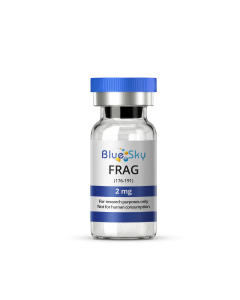
Fragment 176-191 is supplied as a lyophilized white powder at 2 mg per vial.
Important Notice
This product is intended for laboratory research use (in vitro) only. It is not approved for human use under any circumstances, and has not been evaluated for safety or efficacy in humans.
References
1. Harvey S, Martinez-Moreno CG. Growth Hormone: Therapeutic Possibilities—An Overview. Int J Mol Sci. 2018;19(7):2015.
- Free Priority Shipping
- With Purchase over $75 | USA ONLY