AOD-9604 2mg
Availability: In stock

- Free Priority Shipping
- With Purchase over $75 | USA ONLY



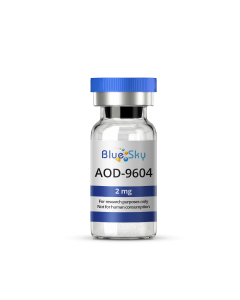
Buy AOD-9604 2mg :
| Unit Size | 2 mg/vial |
| Unit Quantity | 1 vial |
| Purity (Mass Spectrometry and UV) | 99.64% |
| Sequence | H-Tyr-Leu-Arg-Ile-Val-Gln-Cys(1)-Arg-Ser-Val-Glu-Gly-Ser-Cys(1)-Gly-Phe-OH |
| Molecular Formula | C78H123N23O23S2 |
| Appearance | Lyophilized White Powder |
| Source | Chemical Synthesis |
| Storage |
Lyophilized AOD-9604 is stable at room temperature for 90 days; however, it is best stored in a freezer at -20°C for any extended period of time. |
| Terms |
The products we offer are intended for laboratory research use only. Please familiarize yourself with our terms of service prior to ordering. |
| COA Verification | Verify this COA on MZ Biolabs → |
AOD-9604 2mg
View Research Overview
AOD9604 is a synthetic peptide fragment derived from the C-terminal region of growth hormone (hGH), studied in laboratory research as a structurally isolated fragment with properties distinct from the intact hormone. Research referenced here is limited to in vitro (cell-based) laboratory studies. This product is studied in vitro and is not intended for human use or consumption.
Why This Fragment Is Studied Separately from Full-Length hGH
AOD9604 corresponds to the C-terminal region of growth hormone, a segment structurally separated from the portion of hGH responsible for its growth-promoting, IGF-1-driving signaling. Isolating this fragment allows researchers to study its cell-level properties independent of full-length hGH's broader hormonal activity.
This structural distinction is the basis for using AOD9604 as a research tool: because it lacks most of the hGH sequence, it is of interest for studying a small, defined peptide fragment's behavior in cell-based systems without the complexity of the intact hormone.
Analytical Verification of Amino Acid Composition
AOD9604's sequence contains one tyrosine residue and one phenylalanine residue, aromatic amino acids that provide a distinct UV absorbance signature researchers use alongside mass spectrometry to confirm peptide identity.
Because the peptide also contains an internal disulfide bond, analytical verification typically distinguishes between the intact, disulfide-bonded form and any reduced (open-chain) form present in a sample, since the two forms differ measurably in mass and in their behavior under non-reducing versus reducing chromatography conditions.
Storage and Handling in the Laboratory Setting
Because AOD9604 contains an internal disulfide bond between its two cysteine residues, laboratories generally avoid reducing agents and excessive mechanical agitation when handling the compound, both of which can disrupt this bond and alter the peptide's folded structure.
Standard practice involves storing the lyophilized powder under sub-zero freezer conditions, which helps preserve structural integrity across the assay types referenced in this research summary.
Counting the Sixteen Residues
The sequence shown in the specification table runs to sixteen residues, and the arithmetic behind that figure is worth stating plainly because it is often reported inconsistently.
Fifteen of those residues reproduce the final fifteen of the growth hormone chain, positions 177 through 191. The sixteenth is the tyrosine at the start, which is not drawn from the hormone's own sequence at that position but added at the N-terminus as part of the analog's design.
Descriptions that call this a fifteen-residue fragment are counting only the hormone-derived portion and omitting the added residue. Counting the sequence directly resolves the question.
A Single Atom Apart from Fragment 176-191
AOD9604 and Fragment 176-191 are among the most frequently confused compounds in this category, and the chemical distance between them is as small as it can be.
Both are sixteen residues long. Fifteen of those residues are identical, in identical order, and both carry the same internal disulfide bond between the cysteines at positions 7 and 14. They diverge at position 1 alone, where Fragment 176-191 carries phenylalanine and AOD9604 carries tyrosine.
Tyrosine is phenylalanine with a hydroxyl group added to its aromatic ring. The entire difference between the two compounds is therefore one oxygen atom, which the molecular formulas reflect exactly: this peptide is listed with twenty-three oxygens against the other's twenty-two. The mass difference is approximately 16 units.
How the Tyrosine Changes the Analysis
That single hydroxyl group has a disproportionate effect on how each peptide is detected. Tyrosine absorbs ultraviolet light strongly near 280 nanometres; phenylalanine absorbs only weakly and at shorter wavelengths.
AOD9604 therefore produces a clear signal at 280 nm, while Fragment 176-191, containing neither tyrosine nor tryptophan, produces almost none and must be monitored at 214 to 220 nanometres where the peptide bonds themselves absorb.
Two independent handles are therefore available for telling the compounds apart: a 16-unit mass difference and the presence or absence of 280 nm absorbance. Either one settles the question; together they leave no ambiguity.
What a Certificate of Analysis Should Confirm
Given how close the two sequences are, the reported mass is the field that carries the most weight on a certificate for this compound. A value consistent with the twenty-three-oxygen formula confirms the tyrosine-containing analog; a value 16 units lower would indicate the other fragment.
Alongside that, a complete certificate addresses chromatographic purity, the disulfide state of the material, and the lot number tying the data to the vial in hand. Confirming the mass rather than accepting the product name is the step that distinguishes these two compounds in practice.
Alternate Names in the Literature
This peptide appears in published work and supplier catalogs as AOD-9604, AOD9604, AOD 9604, and Tyr-hGH Fragment 177-191. Each refers to the same sixteen-residue sequence shown in the specification table above.
Important Note
These findings are based exclusively on in vitro laboratory research. This product is not intended for human use or consumption, and has not been evaluated for safety or efficacy in humans outside of controlled in vitro laboratory research.
Summary
AOD9604 continues to be studied in cell-based laboratory models for its structural and analytical properties as a synthetic C-terminal hGH fragment. Its use remains strictly limited to in vitro laboratory research applications.
- Free Priority Shipping
- With Purchase over $75 | USA ONLY

-
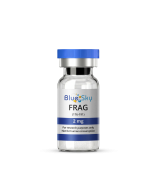 FRAGMENT 176-191 2mgSpecial Price $25.58 Regular Price $63.95
-
-
-