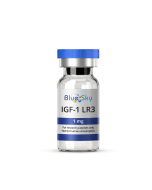
Shop IGF1-LR3 1mg
Availability: In stock
- Buy 10 for $76.95 each and save 42%

- Free Priority Shipping
- With Purchase over $75 | USA ONLY



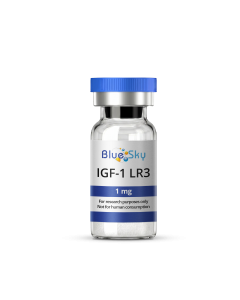
Buy Bulk Premium Recombinant Research Grade IGF-1 LR3 1mg ( No Promo Codes):
| Unit Size | 1 mg/vial |
| Unit Quantity | 1 vial |
| Purity (Mass Spectrometry and UV) | 99.02% |
| Sequence | MFPAMPLSSL FVNGPRTLCG AELVDALQFV CGDRGFYFNK PTGYGSSSRR APQTGIVDEC CFRSCDLRRL EMYCAPLKPA KSA |
| Molecular Formula | C400H625N111O115S9 |
| Appearance | Lyophilized White Powder |
| Source | Recombinant Synthesis |
| Storage | Lyophilized IGF-1 LR3 is stable at room temperature for 90 days; however, it is best stored in a freezer at -20°C for any extended period of time. |
| Terms | The products we offer are intended for laboratory research use only. Please familiarize yourself with our terms of service prior to ordering. |
| COA Verification | Verify this COA on Freedom Diagnostics → |
IGF-1 LR3 1mg (Bulk)
View Research Overview
IGF-1 LR3 is produced recombinantly rather than through solid-phase chemical synthesis, reflecting its size: at 83 residues, it is considerably larger than the short synthetic peptides that make up most of this catalog.
Recombinant Production and Sequence Modifications
IGF-1 LR3's sequence differs from native IGF-1 through an arginine substitution at position 3 and a 13-residue N-terminal extension, together reducing the molecule's affinity for several IGF-binding protein (IGFBP) family members that would otherwise regulate its availability.
These modifications leave IGF-1 LR3 more available to interact directly with IGF-1 receptors in cell-based laboratory assays relative to native IGF-1, a property researchers cite as the basis for using this variant in in vitro receptor-signaling studies.
Analytical Verification for a Recombinant Protein
Unlike shorter synthetic peptides verified primarily by HPLC and mass spectrometry, a full-length 83-residue recombinant protein like IGF-1 LR3 requires methods suited to larger biomolecules, including SDS-PAGE or size-exclusion chromatography to confirm molecular size and rule out aggregation.
For bulk orders, researchers are encouraged to confirm that analytical data reflects the specific expression batch supplied, since recombinant production can introduce more batch-to-batch variability than solid-phase chemical synthesis.
Storage and Handling in the Laboratory Setting
Larger recombinant proteins are more sensitive than short synthetic peptides to repeated temperature cycling, since the folded structure can begin to loosen across many warming and cooling events even while the material remains in its dry state.
Lyophilized storage under sub-zero freezer conditions remains standard, and a bulk shipment is generally split into a number of smaller sealed containers immediately after arrival so that only one portion at a time is subject to ambient conditions.
Comparative Research Context Among Reduced-Affinity IGF-1 Analogs
IGF-1 LR3 is one of several IGF-1 analogs engineered to reduce IGFBP binding, alongside des(1-3)IGF-1, which achieves a similar reduction through N-terminal truncation rather than extension.
Researchers comparing these analogs against native IGF-1 have used their differing IGFBP affinities to isolate IGF-1-receptor-mediated effects from the modulating influence of binding proteins in cell-based assay systems.
Reading the Modifications in the Sequence
Both engineered changes are visible directly in the sequence shown above. The first thirteen residues, MFPAMPLSSLFVN, are the added N-terminal extension and have no counterpart in native IGF-1. The native sequence begins at residue 14.
The substitution appears three residues later. Where native IGF-1 opens GPE, this analog reads GPR, the glutamate at position 3 of the native chain replaced by arginine. Exchanging an acidic residue for a basic one at that position is what accounts for much of the reduced IGFBP affinity, and the two changes together give the molecule its LR3 designation: Long chain, Arg at position 3.
Three Disulfide Bonds and Correct Folding
The sequence contains six cysteine residues, which pair into three intramolecular disulfide bonds. Together with the three methionines, these account for the nine sulfur atoms in the molecular formula.
For a recombinant protein of this size, correct disulfide pairing is the central quality consideration. Six cysteines can in principle pair in fifteen different combinations, and only one of those is the native arrangement. A misfolded isomer has exactly the same molecular formula and mass as the correctly folded protein, so mass spectrometry alone cannot distinguish them.
This is why reversed-phase HPLC retention behavior, which does differ between folding isomers, forms part of the analytical picture for this product rather than mass confirmation on its own.
Why Recombinant Production Rather Than Chemical Synthesis
Assembling an 83-residue chain by solid-phase synthesis would require 82 sequential coupling steps. Even at a 99% success rate per step, the theoretical yield of full-length material falls to roughly 44%, with the remainder consisting of deletion sequences that are difficult to separate from the target.
Expressing the protein in a host organism avoids that accumulation of stepwise error and allows the cell's own machinery to assist with folding, which is why proteins beyond roughly 50 residues are generally produced this way.
Alternate Names in the Literature
This protein appears in published work and supplier catalogs as IGF-1 LR3, Long R3 IGF-1, LR3 IGF-1, and Long Arg3 Insulin-like Growth Factor-1. Each refers to the same 83-residue sequence shown in the specification table above.
Important Compliance Notice
IGF-1 LR3 is intended solely for laboratory research use (in vitro) and is not approved for human, therapeutic, or diagnostic use. Any application outside controlled in vitro research environments is prohibited. These findings do not establish safety, efficacy, or suitability for any human application, and this product has not been evaluated by the FDA or any regulatory agency.
Product Information
IGF-1 LR3 is supplied as a research reagent for laboratory use only, available in bulk quantity.
- Free Priority Shipping
- With Purchase over $75 | USA ONLY