Buy Bulk GHRP-2 5mg
Availability: In stock
- Buy 50 for $14.95 each and save 68%
- Buy 100 for $13.95 each and save 70%
- Buy 200 for $11.95 each and save 74%

- Free Priority Shipping
- With Purchase over $75 | USA ONLY



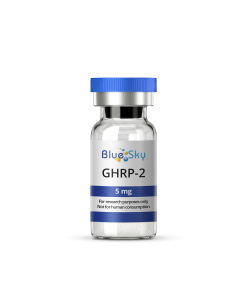
Buy Bulk GHRP-2 (No Promo Codes):
| Unit Size | 5 mg/vial |
| Unit Quantity | 1 vial |
| Purity (Mass Spectrometry and UV) | 98.07% |
| Sequence | H-D-Ala-D-2-Nal-Ala-Trp-D-Phe-Lys-NH2 |
| Molecular Formula | C45H55N9O6 |
| Appearance | Lyophilized White Powder |
| Source | Chemical Synthesis |
| Storage | Lyophilized GHRP-2 is stable at room temperature for 90 days; however, it is best stored in a freezer at -20°C for any extended period of time. |
| Terms | The products we offer are intended for laboratory research use only. Please familiarize yourself with our terms of service prior to ordering. |
| COA Verification | Verify this COA on MZ Biolabs → |
GHRP-2 5mg (Bulk)
View Research Overview
GHRP-2, also referenced in the literature as Pralmorelin or KP-102, is a synthetic hexapeptide belonging to the growth hormone-releasing peptide class of ghrelin mimetics.
Ghrelin Mimicry as a Research Design Principle
GHRP-class peptides are studied as synthetic mimetics of ghrelin, the endogenous hormone that activates the growth hormone secretagogue receptor (GHS-R), despite sharing little sequence similarity with the natural hormone itself.
This mimetic relationship is a foundational concept in secretagogue research, since it demonstrates that GHS-R activation can be achieved through a synthetic peptide scaffold structurally distinct from the receptor's natural ligand.
Aromatic Residue Content and Analytical Detection
GHRP-2's sequence contains three aromatic residues, D-2-naphthylalanine, D-phenylalanine, and tryptophan, giving the peptide a strong UV chromophore profile useful for spectroscopic detection during chromatographic purity work.
This aromatic content also means synthesis-related side reactions involving these bulky side chains are a relevant consideration when reviewing analytical data, since incomplete coupling at any of the three positions can generate byproducts of similar mass to the intact peptide.
Cell-Based Receptor Assay Design
Characterizing GHS-R ligands in the laboratory typically relies on cell lines engineered to express the receptor of interest, isolating ligand binding and downstream signaling from the many other pathways active in a whole organism.
Analytical Purity Verification for Bulk Quantities
Combined HPLC and mass spectrometry confirm correct sequence assembly and the absence of deletion or truncation byproducts.
For bulk orders, researchers are encouraged to confirm that purity data corresponds to the specific production batch supplied, since consistency across a larger quantity is a relevant consideration for experiments requiring reproducible receptor-binding behavior across replicate assays.
Storage and Handling in the Laboratory Setting
Lyophilized GHRP-2 is stored under sub-zero freezer conditions, with the powder kept away from prolonged light exposure given its aromatic residue content.
Because bulk shipments represent a larger total quantity, many laboratories repackage stock into several smaller sealed units at intake, reducing the ambient light and temperature exposure any single unit accumulates over repeated use.
D-2-Naphthylalanine as an Unnatural Building Block
The residue at position 2 is not one of the twenty amino acids found in natural proteins. D-2-naphthylalanine carries a naphthalene group, two fused benzene rings, attached through a methylene bridge to the peptide backbone.
This bicyclic ring system is considerably larger and more rigid than a phenyl group, and it is incorporated during synthesis from a dedicated Fmoc-protected building block rather than a standard amino acid. Its presence in the D-configuration also places it outside the recognition pattern of most common proteases.
How GHRP-2 Differs from the GHRP-6 Scaffold
GHRP-2 and GHRP-6 share the same chain length and are identical across their final four positions. The differences sit entirely in the first two residues.
Where GHRP-6 opens with histidine followed by D-tryptophan, GHRP-2 opens with D-alanine followed by D-2-naphthylalanine. Replacing histidine removes the imidazole ring, which in GHRP-6 is partially protonated near neutral pH, so GHRP-2 has no pH-sensitive side chain in that position. Substituting naphthalene for indole exchanges one bulky aromatic system for another while removing a hydrogen-bond donor.
Nitrogen Content as an Identity Check
The two substitutions described above also explain the difference in elemental composition between the two peptides. Histidine contributes two nitrogen atoms through its imidazole ring and tryptophan one through its indole, while alanine and naphthylalanine contribute none from their side chains.
GHRP-2 therefore carries nine nitrogen atoms against GHRP-6's twelve, a three-atom difference that follows directly from the sequence and offers a quick consistency check when reviewing a certificate of analysis.
Hydrophobicity and Retention Behavior
The naphthalene ring makes GHRP-2 notably more hydrophobic than other members of the GHRP family. On reversed-phase columns this translates into longer retention, so GHRP-2 generally elutes later than GHRP-6 under comparable gradient conditions.
Laboratories running several secretagogues through the same analytical method often find the elution order a useful confirmation alongside mass data.
The C-Terminal Amide and a Related Byproduct
The lysine at position 6 terminates in an amide rather than a free carboxyl group. This is a deliberate feature of the molecule, and it removes the negative charge a free C-terminus would otherwise carry.
Incomplete amidation during synthesis, or hydrolysis of the amide afterward, produces the corresponding free-acid form. That byproduct is approximately 1 Da heavier than the intended peptide, a small enough shift that high-resolution mass spectrometry is what reliably distinguishes it.
Alternate Names and Development Codes
This compound appears in published work and supplier catalogs as GHRP-2, GHRP 2, Pralmorelin, KP-102, and Growth Hormone Releasing Peptide-2. Each refers to the same six-residue sequence shown in the specification table above.
Important Notice
GHRP-2 is intended strictly for laboratory research use (in vitro) and is not approved for human use. Any application outside of controlled research environments is strictly prohibited. These findings do not establish safety, efficacy, or suitability for any human application, and this product has not been evaluated by the FDA or any regulatory agency.
Product Information
GHRP-2 is supplied as a research reagent for laboratory use only, available in bulk quantity.
- Free Priority Shipping
- With Purchase over $75 | USA ONLY

-
-
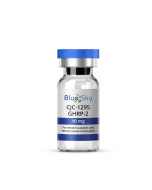 Blend CJC 1295 NO DAC 5mg with GHRP-2 5mgSpecial Price $39.98 Regular Price $99.95