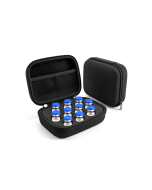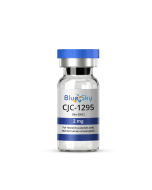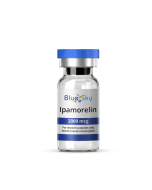
Blend CJC 1295 NO DAC 2mg with Ipamorelin 2mg
Availability: In stock

- Free Priority Shipping
- With Purchase over $75 | USA ONLY



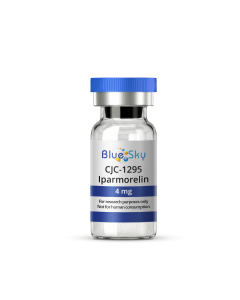
Buy 2 Get 1 Free Blend CJC 1295 NO DAC 2mg with Ipamorelin 2mg:
| Unit Size | 4 mg/vial |
| Unit Quantity | 1 vial |
| Purity (Mass Spectrometry and UV) | 99.71% Nominal Target: 2 mg CJC 1295 NO DAC + 2 mg Ipamorelin |
| Sequence (CJC 1295 NO DAC) | H-Tyr-D-Ala-Asp-Ala-Ile-Phe-Thr-Gln-Ser-Tyr-Arg-Lys-Val-Leu-Ala-Gln-Leu-Ser-Ala-Arg-Lys-Leu-Leu-Gln-Asp-Ile-Leu-Ser-Arg-NH2 |
| Sequence (Ipamorelin) | Aib-His-D-2-Nal-D-Phe-Lys-NH2 |
| Molecular Formula (CJC 1295 NO DAC) |
C152H252N44O42 |
| Molecular Formula (Ipamorelin) | C38H49N9O5 |
| Appearance | Lyophilized White Powder |
| Source | Chemical Synthesis |
| Storage | Lyophilized Blend CJC 1295 NO DAC with Ipamorelin is stable at room temperature for 90 days; however, it is best stored in a freezer at -20°C for any extended period of time. |
| Terms | The products we offer are intended for laboratory research use only. Please familiarize yourself with our terms of service prior to ordering. |
| COA Verification | Verify this COA on MZ Biolabs → |
Blend CJC-1295 NO-DAC 2mg with Ipamorelin 2mg
View Research Overview & References
This blend combines two synthetic peptides: CJC-1295 NO-DAC and Ipamorelin, studied together in vitro for their interaction with two distinct receptor pathways involved in growth hormone signaling research.
CJC-1295 NO-DAC is a 29-amino-acid analog of growth hormone-releasing hormone (GHRH) that engages the GHRH receptor, while Ipamorelin is a 5-amino-acid peptide that engages the growth hormone secretagogue receptor (GHS-R). This formulation does not contain the drug affinity complex (DAC) used in a related CJC-1295 variant.
Structural Distinction: NO-DAC Versus DAC-Conjugated Analogs
The DAC-conjugated form of CJC-1295 carries an added maleimidopropionic acid group capable of forming a covalent bond with a free thiol on albumin, a modification designed to extend the molecule's presence in solution. The NO-DAC form used in this blend lacks this conjugation site entirely, leaving the 29-residue GHRH-analog sequence unmodified at its C-terminus.
Researchers selecting between these two structural variants for a given experimental design consider this conjugation difference a primary factor, since it changes the molecule's size, charge distribution, and behavior in size-exclusion or affinity-based analytical methods.
GHRH Receptor Binding Research
Structural and computational research has examined the dynamic properties of the GHRH receptor and the molecular determinants of GHRH binding, providing researchers a receptor-level framework for interpreting how unconjugated GHRH analogs like CJC-1295 NO-DAC are expected to engage this receptor.1
Ipamorelin Structural Considerations
Ipamorelin's sequence includes D-2-naphthylalanine, a non-natural amino acid studied for its role in GHS-R binding affinity, along with an Aib (2-aminoisobutyric acid) residue at the N-terminus that is thought to add resistance to enzymatic degradation relative to standard amino acids.
Molar Mass Considerations for a Two-Component Blend
Because this vial contains two peptides of different molecular weights combined at a 1:1 mass ratio (2 mg each), the two components are not present in equal molar quantities despite their equal mass, since molar quantity depends on molecular weight as well as mass.
This distinction matters for any assay comparing molar potency or receptor occupancy between the two components, since researchers cannot assume equal mass corresponds to equal molar contribution from each peptide.
Storage and Handling in the Laboratory Setting
Because this blend contains two peptides with different degradation sensitivities, researchers generally treat the combined vial with the more conservative handling requirements of the two components rather than the average of the two.
Standard practice is sub-zero freezer storage of the lyophilized powder, since Ipamorelin's aromatic residues and CJC-1295 NO-DAC's longer chain length each introduce their own routes of degradation over time if stored improperly.
Why "NO-DAC" Appears in the Product Name
The parent compound, CJC-1295, was developed with the drug affinity complex attached. The unconjugated form is therefore named for what it does not carry rather than for what it is, which is why the same 29-residue sequence appears in the literature and in supplier catalogs under more than one name.
CJC-1295 no-DAC, CJC-1295 without DAC, and MOD GRF 1-29 all refer to the sequence shown in the specification table above. Researchers comparing material between sources are better served matching on sequence than on name, since the naming conventions vary between suppliers while the sequence does not.
Three of Ipamorelin's Five Residues Are Non-Standard
Only histidine and lysine appear in Ipamorelin as ordinary L-amino acids. The remaining three positions do not: Aib is not one of the twenty proteinogenic amino acids at all, and both D-2-naphthylalanine and D-phenylalanine are D-configured.
That is a high proportion of modified positions for a sequence this short, and it is a deliberate design feature rather than an incidental one. Each of those substitutions removes a site that an L-specific peptidase would otherwise recognize, which is what allows a five-residue chain to hold together under conditions that would rapidly degrade an all-L pentapeptide.
Why Neither Component Could Be Produced in a Host Organism
The Source row above reads Chemical Synthesis for both peptides, and in this case that is not a matter of cost. Ribosomal protein synthesis draws on the twenty L-amino acids and nothing else.
Aib, D-2-naphthylalanine, D-phenylalanine, and the D-alanine at position 2 of CJC-1295 NO-DAC all sit outside that set, so neither peptide in this vial has a sequence a cell could be engineered to express. Solid-phase synthesis, which assembles the chain from activated building blocks one residue at a time, carries no such restriction.
Aib Carries No Stereocenter
Every residue in the sequences above is labeled L or D except Aib, and that is not an omission. 2-aminoisobutyric acid carries two methyl groups on its alpha carbon, in place of the single methyl and single hydrogen that alanine has at the same position.
Because those two methyl groups are identical, that carbon is not a stereocenter, and there is no D or L form of Aib to specify. The same quaternary carbon also restricts the angles the backbone can adopt at that position, which is why Aib appears often in peptides designed around a constrained geometry.
Important Notice
This product is intended exclusively for in vitro laboratory research and is not for human use or consumption. All findings referenced here are based on in vitro research, and have not been evaluated for safety or efficacy in humans. This product is strictly for laboratory use to explore biochemical mechanisms under controlled experimental conditions.
Product Information
Blue Sky Peptide's Blend CJC-1295 NO-DAC with Ipamorelin is available as a white lyophilized powder, 4 mg per vial.
References
1. Matsoukas MT, Spyroulias GA. Dynamic properties of the growth hormone-releasing hormone receptor (GHRHR) and molecular determinants of GHRH binding. Mol Biosyst. 2017;13(7):1313-1322.
- Free Priority Shipping
- With Purchase over $75 | USA ONLY

-
 CJC-1295 NO-DAC 2mg (MOD GRF 1-29)Special Price $23.58 Regular Price $58.95
-
 IPAMORELIN 2000mcgSpecial Price $16.78 Regular Price $41.95
-
 Blend CJC 1295 NO DAC 5mg with Ipamorelin 5mgSpecial Price $54.38 Regular Price $135.95
-
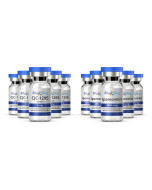 Bundle (CJC-1295 No Dac 2mg x5 + Ipamorelin 2mg x5)Special Price $95.98 Regular Price $239.95