Buy Bulk MGF (Mechano Growth Factor) 2mg
Availability: In stock
- Buy 50 for $14.95 each and save 73%
- Buy 100 for $13.95 each and save 75%
- Buy 200 for $12.95 each and save 77%

- Free Priority Shipping
- With Purchase over $75 | USA ONLY



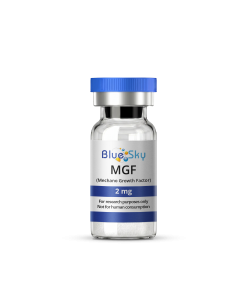
Buy Bulk MGF (Mechano Growth Factor) 2mg (No Promo Codes):
| Unit Size | 2 mg/vial |
| Unit Quantity | 1 vial |
| Purity (Mass Spectrometry and UV) | 99.09% |
| Sequence | H-Tyr-Gln-Pro-Pro-Ser-Thr-Asn-Lys-Asn-Thr-Lys-Ser-Gln-Arg-Arg-Lys-Gly-Ser-Thr-Phe-Glu-Glu-His-Lys-NH2 |
| Molecular Formula | C121H200N42O39 |
| Appearance | Lyophilized White Powder |
| Source | Chemical Synthesis |
| Storage | Lyophilized MGF is stable at room temperature for 90 days; however, it is best stored in a freezer at -20°C for any extended period of time. |
| Terms | The products we offer are intended for laboratory research use only. Please familiarize yourself with our terms of service prior to ordering. |
| COA Verification | Verify this COA on MZ Biolabs → |
MGF (Mechano Growth Factor) 2mg (Bulk)
View Research Overview & References
Mechano Growth Factor (MGF) is a synthetic 24-residue peptide corresponding to the E-domain of IGF-1Ec, a splice variant of insulin-like growth factor 1 (IGF-1) distinct from the mature, receptor-binding form of the hormone.
Muscle Progenitor Cell Research
Researchers studying the MGF-E peptide in muscle progenitor cells reported that it activated these cells and boosted their capacity to fuse into myotubes, an effect seen consistently across progenitor cells sourced from donors spanning a range of ages.1
Neuronal Cell Stress Research
In vitro studies using SH-SY5Y cells, an established neuroblastoma cell line, examined MGF's effects against toxicity induced by 6-hydroxydopamine, rotenone, and MPP+, three compounds commonly used to model neurotoxic stress in cultured neuronal cells.
MGF was found to inhibit apoptosis and prevent mitochondrial membrane depolarization in this cell-based system, with the effect linked to heme oxygenase-1 (HO-1) rather than Akt signaling, distinguishing its mechanism from IGF-1's own signaling pathway.2
Peptide Structure: The E-Domain Versus Mature IGF-1
MGF corresponds to the C-terminal E-domain cleaved away during processing of the full IGF-1 precursor, distinguishing it structurally from the 70-amino-acid mature IGF-1 protein that retains the classic IGF-1 receptor-binding domains.
Its basic core, rich in lysine and arginine residues, combined with a short acidic Glu-Glu segment near the C-terminus, gives MGF a charge and solubility profile distinct from mature IGF-1.
Analytical Purity Verification for Bulk Quantities
As a 24-residue peptide with several basic residues clustered together, MGF synthesis is prone to specific byproducts such as incomplete couplings around the arginine- and lysine-rich core.
For bulk orders, researchers are encouraged to confirm that combined HPLC and mass spectrometry data reflects the specific production batch supplied, since this clustering can affect batch-to-batch consistency more than in peptides with a more even charge distribution.
Storage and Handling in the Laboratory Setting
Lyophilized MGF is stored under sub-zero freezer conditions to preserve integrity, since degradation could otherwise introduce variability into cell-based assays examining progenitor cell activation or other MGF-related signaling endpoints.
When a bulk shipment arrives, most laboratories immediately redistribute it across multiple smaller vials rather than keeping the full quantity in one container, since each time a large container is opened its remaining contents face a fresh round of exposure to air and ambient temperature.
Where the E-Domain Sits in the Precursor
IGF-1 is not produced in its finished form. It is translated as a longer precursor built in three parts: a signal sequence at the front, the mature hormone in the middle, and an extension domain at the end.
Processing removes the signal sequence first, then cleaves away the trailing extension, leaving the mature seventy-residue hormone. That trailing extension is the E-domain, and the twenty-four residues reproduced in this product come from it.
The sequence supplied here is therefore a piece of the precursor that processing discards, not a fragment of the finished hormone. This is the structural reason it carries none of the receptor-binding regions that define mature IGF-1.
Why This One Is Made Synthetically
The Source row above reads Chemical Synthesis, while the related IGF-1 LR3 product is produced recombinantly. The difference is chain length.
At twenty-four residues, MGF requires twenty-three coupling steps, which sits comfortably within the range solid-phase synthesis handles well. An eighty-three-residue protein requires eighty-two, and the accumulated losses across that many steps make expression in a host organism the practical route instead.
Synthesis also gives tighter control over the exact sequence, with no expression construct, host cell, or purification from cellular material involved.
A Quarter of the Sequence Carries Hydroxyl Groups
Reading along the chain, serine appears at positions 5, 12 and 18, and threonine at positions 6, 10 and 19. Six of the twenty-four residues therefore carry a hydroxyl group on their side chain.
That is a high proportion, and it contributes to the peptide's hydrophilic character alongside its basic residues. In full-length proteins, serine and threonine are the most common sites of phosphorylation, which is one reason this residue class attracts attention in sequences studied for signaling behavior.
Alternate Names in the Literature
This peptide appears in published work and supplier catalogs as MGF, Mechano Growth Factor, MGF-24aa-E, and the Mechano Growth Factor E peptide. The parent transcript is designated IGF-1Ec. Each refers to the same twenty-four-residue sequence shown in the specification table above.
Important Notice
This product is strictly intended for in vitro laboratory research use only. It is not approved for any form of human consumption, diagnostic procedures, or medical treatment. Its use is restricted to controlled research environments, and these findings do not establish safety, efficacy, or suitability for any human application.
Product Information
MGF is supplied as a research reagent for laboratory use only, available in bulk quantity.
References
1. Kandalla PK, Goldspink G, Butler-Browne G, Mouly V. Mechano Growth Factor E peptide (MGF-E), derived from an isoform of IGF-1, activates human muscle progenitor cells and induces an increase in their fusion potential at different ages. Mech Ageing Dev. 2011;132(4):154-162.
2. Quesada A, Micevych P, Handforth A. C-terminal mechano growth factor protects dopamine neurons: a novel peptide that induces heme oxygenase-1. Exp Neurol. 2009;220(2):255-266.
- Free Priority Shipping
- With Purchase over $75 | USA ONLY